OpenTelementry
OpenShift has various tracing features, one of which is based on OpenTelemetry. From an upstream perspective, OpenTelemetry is a server and client architecture, with the server called the collector and the client called instrumentation. The collector is responsible for receiving data from the client and then exporting it to backends such as Tempo, Jaeger, Zipkin, etc. The instrumentation is responsible for collecting data from the application and then sending it to the collector.
For instrumentation, OpenTelemetry provides support for various languages, including Java, Python, Go, etc. One form of instrumentation is as a static library, which is statically linked to your program. Another form is as an agent; for Java, the agent is based on Java bytecode. When you start Java, you can add the agent to the command line or via an environment variable to start the agent. The agent will then collect data and send it to the collector.
For OpenShift’s integration with OpenTelemetry, the recommended approach is to use the auto-injection method, which sets environment variables and starts the Java application. In this manner, the application will be automatically instrumented and send data to the collector without requiring any application code changes.
Here is the arch of this lab:
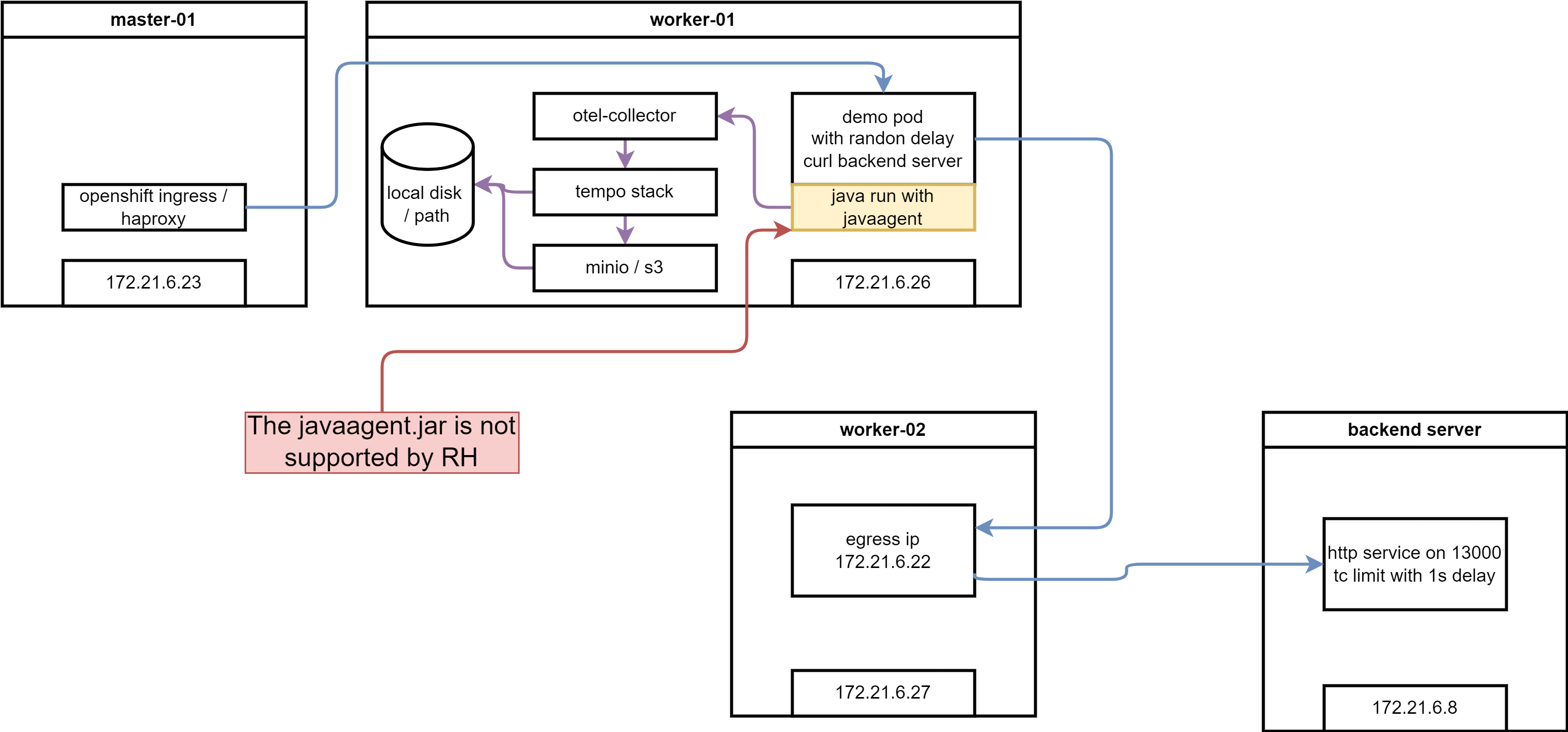
🚨🚨🚨 Please notes, openshift only support the auto-inject behavior (it is in TP, but can be moved to GA at anytime with customer requirement), but not the agent.jar liberary.
try on rhel
We will try 3 example on rhel, one is manual inject, and the other is auto inject.
manual export
upstream project has a example, to export telementry by changing the java code, and import lib only, no byte-code injection, this is suitable for developer team to control the telementry, not the operation team. And it avoid the security concern around byte-code injection. We try it out.
- https://github.com/wangzheng422/opentelemetry-java-examples
build the container image
# on vultr
# dnf install -y /usr/bin/javac

dnf install -y java-latest-openjdk-devel java-1.8.0-openjdk-devel java-11-openjdk-devel java-17-openjdk-devel java-21-openjdk-devel

dnf install -y /usr/bin/podman-compose /usr/bin/mvn

yum-config-manager --add-repo https://download.docker.com/linux/centos/docker-ce.repo

yum install -y docker-ce docker-ce-cli containerd.io docker-buildx-plugin docker-compose-plugin

systemctl enable --now docker


mkdir -p /data
cd /data

git clone https://github.com/wangzheng422/opentelemetry-java-examples

cd /data/opentelemetry-java-examples/spring-native

git checkout wzh-2024-04-14

../gradlew bootBuildImage --imageName=otel-native-graalvm-wzh

# save the image

docker tag otel-native-graalvm-wzh quay.io/wangzheng422/qimgs:opentelemetry-java-examples-spring-native-2024.04.28

docker push quay.io/wangzheng422/qimgs:opentelemetry-java-examples-spring-native-2024.04.28
start up the test container
docker compose up


# try curl to test
curl http://localhost:8080/ping
you can see the log
collector-1  | 2024-04-29T14:12:32.471Z info    TracesExporter  {"kind": "exporter", "data_type": "traces", "name": "logging", "resource spans": 1, "spans": 2}
collector-1  | 2024-04-29T14:12:32.471Z info    ResourceSpans #0
collector-1  | Resource SchemaURL: https://opentelemetry.io/schemas/1.24.0
collector-1  | Resource attributes:
collector-1  |      -> container.id: Str(56146575ce76572fd4c2c77339904893b301d2d7408e6f662ac91ff7539a7cfd)
collector-1  |      -> host.arch: Str(amd64)
collector-1  |      -> host.name: Str(56146575ce76)
collector-1  |      -> os.description: Str(Linux 5.14.0-362.24.1.el9_3.0.1.x86_64)
collector-1  |      -> os.type: Str(linux)
collector-1  |      -> process.command_args: Slice(["/layers/paketo-buildpacks_bellsoft-liberica/jre/bin/java","org.springframework.boot.loader.launch.JarLauncher"])
collector-1  |      -> process.executable.path: Str(/layers/paketo-buildpacks_bellsoft-liberica/jre/bin/java)
collector-1  |      -> process.pid: Int(1)
collector-1  |      -> process.runtime.description: Str(BellSoft OpenJDK 64-Bit Server VM 21.0.2+14-LTS)
collector-1  |      -> process.runtime.name: Str(OpenJDK Runtime Environment)
collector-1  |      -> process.runtime.version: Str(21.0.2+14-LTS)
collector-1  |      -> service.instance.id: Str(d12d40b9-ebee-485a-80a2-2184b814a32d)
collector-1  |      -> service.name: Str(graal-native-example-app)
collector-1  |      -> telemetry.distro.name: Str(opentelemetry-spring-boot-starter)
collector-1  |      -> telemetry.distro.version: Str(2.3.0-alpha)
collector-1  |      -> telemetry.sdk.language: Str(java)
collector-1  |      -> telemetry.sdk.name: Str(opentelemetry)
collector-1  |      -> telemetry.sdk.version: Str(1.37.0)
collector-1  | ScopeSpans #0
collector-1  | ScopeSpans SchemaURL:
collector-1  | InstrumentationScope io.opentelemetry.spring-webmvc-6.0 2.3.0-alpha
collector-1  | Span #0
collector-1  |     Trace ID       : da7438ff488105fb46a370a1db85d38e
collector-1  |     Parent ID      :
collector-1  |     ID             : 006b79f8f819f0ea
collector-1  |     Name           : GET /ping
collector-1  |     Kind           : Server
collector-1  |     Start time     : 2024-04-29 14:12:27.945406159 +0000 UTC
collector-1  |     End time       : 2024-04-29 14:12:28.29162761 +0000 UTC
collector-1  |     Status code    : Unset
collector-1  |     Status message :
collector-1  | Attributes:
collector-1  |      -> url.scheme: Str(http)
collector-1  |      -> url.path: Str(/ping)
collector-1  |      -> network.peer.address: Str(192.168.112.1)
collector-1  |      -> server.address: Str(localhost)
collector-1  |      -> client.address: Str(192.168.112.1)
collector-1  |      -> user_agent.original: Str(curl/7.76.1)
collector-1  |      -> http.response.status_code: Int(200)
collector-1  |      -> http.route: Str(/ping)
collector-1  |      -> network.protocol.version: Str(1.1)
collector-1  |      -> server.port: Int(8080)
collector-1  |      -> network.peer.port: Int(59600)
collector-1  |      -> http.request.method: Str(GET)
collector-1  | ScopeSpans #1
collector-1  | ScopeSpans SchemaURL:
collector-1  | InstrumentationScope io.opentelemetry.example.graal
collector-1  | Span #0
collector-1  |     Trace ID       : da7438ff488105fb46a370a1db85d38e
collector-1  |     Parent ID      : 006b79f8f819f0ea
collector-1  |     ID             : 9fc94c7ca4f8c40a
collector-1  |     Name           : makeHttpRequest
collector-1  |     Kind           : Client
collector-1  |     Start time     : 2024-04-29 14:12:27.946792873 +0000 UTC
collector-1  |     End time       : 2024-04-29 14:12:28.28559109 +0000 UTC
collector-1  |     Status code    : Unset
collector-1  |     Status message :
collector-1  | Attributes:
collector-1  |      -> url.full: Str(https://mirror.stream.centos.org/9-stream/BaseOS/x86_64/iso/CentOS-Stream-9-20240422.0-x86_64-dvd1.iso.manifest)
collector-1  |      -> component: Str(http)
collector-1  |      -> http.request.method: Str(GET)
collector-1  |  {"kind": "exporter", "data_type": "traces", "name": "logging"}
manual inject
In this example will use bytecode-injection, with java code change, and lib import, to export the log and trace to collector.
- https://github.com/open-telemetry/opentelemetry-java-instrumentation
- https://github.com/wangzheng422/opentelemetry-java-examples
build the container image
# on vultr
# dnf install -y /usr/bin/javac

dnf install -y java-latest-openjdk-devel java-1.8.0-openjdk-devel java-11-openjdk-devel java-17-openjdk-devel java-21-openjdk-devel

dnf install -y /usr/bin/podman-compose

yum-config-manager --add-repo https://download.docker.com/linux/centos/docker-ce.repo

yum install -y docker-ce docker-ce-cli containerd.io docker-buildx-plugin docker-compose-plugin

systemctl enable --now docker

mkdir -p /data
cd /data

git clone https://github.com/wangzheng422/opentelemetry-java-examples

cd /data/opentelemetry-java-examples/javaagent

git checkout wzh-2024-04-14

# ../gradlew --no-build-cache --no-configuration-cache bootJar
../gradlew bootJar
start up the container
This demo, consist a sample java app, will accept http call at /ping, and send http request to backend web service, wait the backend return, and return to client at last. During the process, it will log some message, and we will use opentelementry to collect the log and trace.
# custom the docker-compose.yml
# change WZH_URL as you need

# start java app and collector locally
docker compose up --build

# call the rest api
curl http://localhost:8080/ping
# pong


# to stop
docker compose down
and you get output from docker collector
collector-1  | Trace ID: 6141f0a97797ca24e5517e147aae4699
collector-1  | Span ID: 41360031730646c6
collector-1  | Flags: 1
collector-1  |  {"kind": "exporter", "data_type": "logs", "name": "logging"}
collector-1  | 2024-04-29T02:06:13.384Z info    TracesExporter  {"kind": "exporter", "data_type": "traces", "name": "logging", "resource spans": 1, "spans": 4}
collector-1  | 2024-04-29T02:06:13.385Z info    ResourceSpans #0
collector-1  | Resource SchemaURL: https://opentelemetry.io/schemas/1.24.0
collector-1  | Resource attributes:
collector-1  |      -> container.id: Str(5fa246b719ff6c09561f9778058d7334cece0cd2b494d2b91a5c11ae789afa2f)
collector-1  |      -> host.arch: Str(amd64)
collector-1  |      -> host.name: Str(5fa246b719ff)
collector-1  |      -> os.description: Str(Linux 5.14.0-362.24.1.el9_3.0.1.x86_64)
collector-1  |      -> os.type: Str(linux)
collector-1  |      -> process.command_args: Slice(["/opt/java/openjdk/bin/java","-jar","-javaagent:/opentelemetry-javaagent.jar","/app.jar"])
collector-1  |      -> process.executable.path: Str(/opt/java/openjdk/bin/java)
collector-1  |      -> process.pid: Int(7)
collector-1  |      -> process.runtime.description: Str(Eclipse Adoptium OpenJDK 64-Bit Server VM 11.0.23+9)
collector-1  |      -> process.runtime.name: Str(OpenJDK Runtime Environment)
collector-1  |      -> process.runtime.version: Str(11.0.23+9)
collector-1  |      -> service.instance.id: Str(d02bdb5f-a050-4eb2-94e2-c4b20cc00773)
collector-1  |      -> service.name: Str(agent-example-app)
collector-1  |      -> telemetry.distro.name: Str(opentelemetry-java-instrumentation)
collector-1  |      -> telemetry.distro.version: Str(2.3.0)
collector-1  |      -> telemetry.sdk.language: Str(java)
collector-1  |      -> telemetry.sdk.name: Str(opentelemetry)
collector-1  |      -> telemetry.sdk.version: Str(1.37.0)
collector-1  | ScopeSpans #0
collector-1  | ScopeSpans SchemaURL:
collector-1  | InstrumentationScope io.opentelemetry.example.javagent.Application
collector-1  | Span #0
collector-1  |     Trace ID       : 6141f0a97797ca24e5517e147aae4699
collector-1  |     Parent ID      : 6c73946faa0b919a
collector-1  |     ID             : 41360031730646c6
collector-1  |     Name           : makeHttpRequest
collector-1  |     Kind           : Internal
collector-1  |     Start time     : 2024-04-29 02:06:10.125153222 +0000 UTC
collector-1  |     End time       : 2024-04-29 02:06:10.552023024 +0000 UTC
collector-1  |     Status code    : Unset
collector-1  |     Status message :
collector-1  | Attributes:
collector-1  |      -> thread.id: Int(27)
collector-1  |      -> thread.name: Str(http-nio-8080-exec-1)
collector-1  | Span #1
collector-1  |     Trace ID       : 6141f0a97797ca24e5517e147aae4699
collector-1  |     Parent ID      : deff680571954317
collector-1  |     ID             : 6c73946faa0b919a
collector-1  |     Name           : doWork
collector-1  |     Kind           : Internal
collector-1  |     Start time     : 2024-04-29 02:06:09.992222888 +0000 UTC
collector-1  |     End time       : 2024-04-29 02:06:10.552045969 +0000 UTC
collector-1  |     Status code    : Unset
collector-1  |     Status message :
collector-1  | Attributes:
collector-1  |      -> thread.id: Int(27)
collector-1  |      -> thread.name: Str(http-nio-8080-exec-1)
collector-1  | ScopeSpans #1
collector-1  | ScopeSpans SchemaURL:
collector-1  | InstrumentationScope io.opentelemetry.http-url-connection 2.3.0-alpha
collector-1  | Span #0
collector-1  |     Trace ID       : 6141f0a97797ca24e5517e147aae4699
collector-1  |     Parent ID      : 41360031730646c6
collector-1  |     ID             : a85b789704e71e62
collector-1  |     Name           : GET
collector-1  |     Kind           : Client
collector-1  |     Start time     : 2024-04-29 02:06:10.176069278 +0000 UTC
collector-1  |     End time       : 2024-04-29 02:06:10.550553842 +0000 UTC
collector-1  |     Status code    : Unset
collector-1  |     Status message :
collector-1  | Attributes:
collector-1  |      -> thread.id: Int(27)
collector-1  |      -> url.full: Str(https://mirror.stream.centos.org/9-stream/BaseOS/x86_64/iso/CentOS-Stream-9-20240422.0-x86_64-dvd1.iso.manifest)
collector-1  |      -> thread.name: Str(http-nio-8080-exec-1)
collector-1  |      -> http.response.status_code: Int(200)
collector-1  |      -> server.address: Str(mirror.stream.centos.org)
collector-1  |      -> network.protocol.version: Str(1.1)
collector-1  |      -> http.request.method: Str(GET)
collector-1  | ScopeSpans #2
collector-1  | ScopeSpans SchemaURL:
collector-1  | InstrumentationScope io.opentelemetry.tomcat-7.0 2.3.0-alpha
collector-1  | Span #0
collector-1  |     Trace ID       : 6141f0a97797ca24e5517e147aae4699
collector-1  |     Parent ID      :
collector-1  |     ID             : deff680571954317
collector-1  |     Name           : GET /ping
collector-1  |     Kind           : Server
collector-1  |     Start time     : 2024-04-29 02:06:09.841673 +0000 UTC
collector-1  |     End time       : 2024-04-29 02:06:10.602714395 +0000 UTC
collector-1  |     Status code    : Unset
collector-1  |     Status message :
collector-1  | Attributes:
collector-1  |      -> server.port: Int(8080)
collector-1  |      -> thread.id: Int(27)
collector-1  |      -> http.response.status_code: Int(200)
collector-1  |      -> url.path: Str(/ping)
collector-1  |      -> network.peer.address: Str(172.21.0.1)
collector-1  |      -> server.address: Str(localhost)
collector-1  |      -> client.address: Str(172.21.0.1)
collector-1  |      -> http.route: Str(/ping)
collector-1  |      -> http.request.method: Str(GET)
collector-1  |      -> network.peer.port: Int(60600)
collector-1  |      -> url.scheme: Str(http)
collector-1  |      -> thread.name: Str(http-nio-8080-exec-1)
collector-1  |      -> user_agent.original: Str(curl/7.76.1)
collector-1  |      -> network.protocol.version: Str(1.1)
collector-1  |  {"kind": "exporter", "data_type": "traces", "name": "logging"}
So, we can see the log message is collected by opentelementry, and send to collector. From the docker file, we can see the java program start with javaagent parameter
ENTRYPOINT java -jar -javaagent:/opentelemetry-javaagent.jar /app.jarwe can see the metric is manually setting by the java program, and send to collector
private void doWork(int sleepTime) throws InterruptedException, IOException {
    Span span = tracer.spanBuilder("doWork").startSpan();
    try (Scope ignored = span.makeCurrent()) {
      Thread.sleep(sleepTime);
save the image
we save the container image, for later use/demo
# save the image

docker tag javaagent-app quay.io/wangzheng422/qimgs:javaagent-app-2024.04.28

docker push quay.io/wangzheng422/qimgs:javaagent-app-2024.04.28
auto inject without code change
We will use a very simple java project, which will accept at /setRequest, and call backend service, and reture. The project will not depend on any lib from opentelementry, and do not contain any java code related with opentelementry.
During start up, it will run with javaagent cmdline parameter, that is byte-code inject, let us see what kind of information it can capture.
- https://github.com/wangzheng422/simple-java-http-server
run the demo app
# checkout
mkdir -p /data
cd /data

git clone https://github.com/wangzheng422/simple-java-http-server

cd /data/simple-java-http-server
mvn clean package

# customize docker-compose.yml
# change WZH_URL as you need

# run with javaagent and collector, to see the result locally
podman-compose up --build

# on localhost, call the rest api to test
curl -vvv http://localhost:8080/sendRequest
The opentelelmentry will collect the log and trace, and send to collector.
ScopeLogs #0
ScopeLogs SchemaURL:
InstrumentationScope com.example.httpservice.MyController
LogRecord #0
ObservedTimestamp: 2024-04-29 01:55:20.068681452 +0000 UTC
Timestamp: 2024-04-29 01:55:20.06867006 +0000 UTC
SeverityText: INFO
SeverityNumber: Info(9)
Body: Str(Response status code: 200 OK)
Trace ID: 19fb1cbaef1e177d1fbd3788d7e9a150
Span ID: 17b56eb0daf4e56a
Flags: 1
        {"kind": "exporter", "data_type": "logs", "name": "logging"}
2024-04-29T01:55:22.619Z        info    TracesExporter  {"kind": "exporter", "data_type": "traces", "name": "logging", "resource spans": 1, "spans": 2}
2024-04-29T01:55:22.619Z        info    ResourceSpans #0
Resource SchemaURL: https://opentelemetry.io/schemas/1.24.0
Resource attributes:
     -> container.id: Str(97155789ad6de578af0d8f7519ac6cc47daaa0e258ee10f8a4836b0d752a0929)
     -> host.arch: Str(amd64)
     -> host.name: Str(97155789ad6d)
     -> os.description: Str(Linux 5.14.0-362.24.1.el9_3.0.1.x86_64)
     -> os.type: Str(linux)
     -> process.command_args: Slice(["/opt/java/openjdk/bin/java","-jar","-javaagent:/opentelemetry-javaagent.jar","/http-service-1.0-SNAPSHOT.jar"])
     -> process.executable.path: Str(/opt/java/openjdk/bin/java)
     -> process.pid: Int(2)
     -> process.runtime.description: Str(Eclipse Adoptium OpenJDK 64-Bit Server VM 22.0.1+8)
     -> process.runtime.name: Str(OpenJDK Runtime Environment)
     -> process.runtime.version: Str(22.0.1+8)
     -> service.instance.id: Str(e145e7c8-ea31-4a01-b064-aeed67103eb4)
     -> service.name: Str(agent-example-app)
     -> telemetry.distro.name: Str(opentelemetry-java-instrumentation)
     -> telemetry.distro.version: Str(2.3.0)
     -> telemetry.sdk.language: Str(java)
     -> telemetry.sdk.name: Str(opentelemetry)
     -> telemetry.sdk.version: Str(1.37.0)
ScopeSpans #0
ScopeSpans SchemaURL:
InstrumentationScope io.opentelemetry.http-url-connection 2.3.0-alpha
Span #0
    Trace ID       : 19fb1cbaef1e177d1fbd3788d7e9a150
    Parent ID      : 17b56eb0daf4e56a
    ID             : 74c35875a5683544
    Name           : GET
    Kind           : Client
    Start time     : 2024-04-29 01:55:19.100572969 +0000 UTC
    End time       : 2024-04-29 01:55:19.867810253 +0000 UTC
    Status code    : Unset
    Status message :
Attributes:
     -> server.address: Str(mirror.stream.centos.org)
     -> network.protocol.version: Str(1.1)
     -> http.request.method: Str(GET)
     -> http.response.status_code: Int(200)
     -> url.full: Str(https://mirror.stream.centos.org/9-stream/BaseOS/x86_64/iso/CentOS-Stream-9-20240422.0-x86_64-dvd1.iso.manifest)
     -> thread.id: Int(41)
     -> thread.name: Str(http-nio-8080-exec-1)
ScopeSpans #1
ScopeSpans SchemaURL:
InstrumentationScope io.opentelemetry.tomcat-7.0 2.3.0-alpha
Span #0
    Trace ID       : 19fb1cbaef1e177d1fbd3788d7e9a150
    Parent ID      :
    ID             : 17b56eb0daf4e56a
    Name           : GET /sendRequest
    Kind           : Server
    Start time     : 2024-04-29 01:55:18.682487829 +0000 UTC
    End time       : 2024-04-29 01:55:20.127925703 +0000 UTC
    Status code    : Unset
    Status message :
Attributes:
     -> user_agent.original: Str(curl/7.76.1)
     -> network.protocol.version: Str(1.1)
     -> network.peer.port: Int(37286)
     -> url.scheme: Str(http)
     -> thread.name: Str(http-nio-8080-exec-1)
     -> url.path: Str(/sendRequest)
     -> network.peer.address: Str(10.89.0.1)
     -> server.address: Str(localhost)
     -> client.address: Str(10.89.0.1)
     -> http.route: Str(/sendRequest)
     -> http.request.method: Str(GET)
     -> server.port: Int(8080)
     -> http.response.status_code: Int(200)
     -> thread.id: Int(41)
        {"kind": "exporter", "data_type": "traces", "name": "logging"}
The output is almost the same with manual inject. So you can see that the java code is not changed, but the opentelementry is able to collect the log and trace, and the information is good enough.
install and configure tempo
To this point, we will try to install opentelementry on ocp, the first step is to configure the storage for opentelementry, we wil use tempo, this is the recommend storage solution from redhat.
create minio as S3
To configure tempo storage, it depends on S3, so we will create a minio as S3.
oc new-project observability

# on helper
S3_NAME='observability'
S3_NS='observability'
S3_IMAGE='docker.io/minio/minio:RELEASE.2021-06-17T00-10-46Z.hotfix.35a0912ff'

cat << EOF > ${BASE_DIR}/data/install/s3-codellama.yaml
---
apiVersion: v1
kind: Service
metadata:
  name: minio-${S3_NAME}
spec:
  ports:
    - name: minio-client-port
      port: 9000
      protocol: TCP
      targetPort: 9000
  selector:
    app: minio-${S3_NAME}

---
apiVersion: route.openshift.io/v1
kind: Route
metadata:
  name: s3-${S3_NAME}
spec:
  to:
    kind: Service
    name: minio-${S3_NAME}
  port:
    targetPort: 9000

---
apiVersion: v1
kind: PersistentVolumeClaim
metadata:
  name: minio-${S3_NAME}-pvc
spec:
  accessModes:
    - ReadWriteOnce
  resources:
    requests:
      storage: 100Gi
  storageClassName: hostpath-csi

---
apiVersion: apps/v1
kind: Deployment
metadata:
  name: minio-${S3_NAME}
  labels:
    app: minio-${S3_NAME}
spec:
  replicas: 1
  selector:
    matchLabels:
      app: minio-${S3_NAME}
  template:
    metadata:
      labels:
        app: minio-${S3_NAME}
    spec:
      initContainers:
        - name: create-demo-dir
          image: docker.io/busybox
          command: ["mkdir", "-p", "/data1/demo"]
          volumeMounts:
            - name: data
              mountPath: "/data1"
      containers:
        - args:
            - server
            - /data1
          env:
            - name: MINIO_ACCESS_KEY
              value:  admin
            - name: MINIO_SECRET_KEY
              value: redhatocp
          image: ${S3_IMAGE}
          imagePullPolicy: IfNotPresent
          name: minio
          nodeSelector:
            kubernetes.io/hostname: "worker-01-demo"
          securityContext:
            allowPrivilegeEscalation: false
            capabilities:
                drop:
                - ALL
            runAsNonRoot: true
            seccompProfile:
                type: RuntimeDefault
          volumeMounts:
            - mountPath: "/data1"
              name: data
      volumes:
        - name: data
          persistentVolumeClaim:
            claimName: minio-${S3_NAME}-pvc

EOF

oc create -n observability -f ${BASE_DIR}/data/install/s3-codellama.yaml
install tempo operator and configure
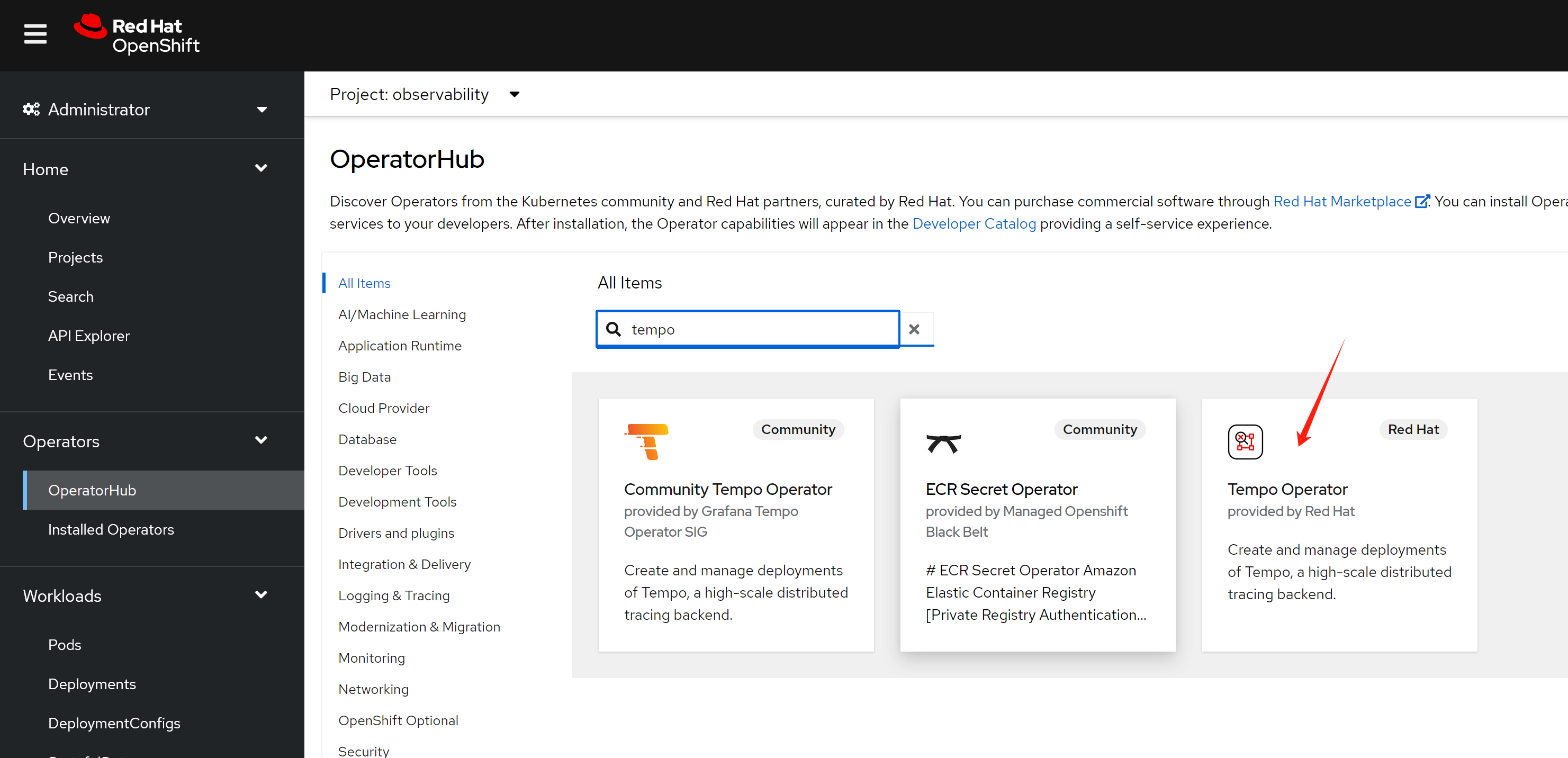
The next step, is to install temp operator from ocp operator hub, just following the offical document.
- https://docs.openshift.com/container-platform/4.14/observability/distr_tracing/distr_tracing_tempo/distr-tracing-tempo-installing.html
S3_NAME='observability'

cat << EOF > ${BASE_DIR}/data/install/tempo-codellama.yaml
---
apiVersion: v1
kind: Secret
metadata:
  name: minio-${S3_NAME}-s3
stringData:
  access_key_id: admin
  access_key_secret: redhatocp
  bucket: demo
  endpoint: http://minio-${S3_NAME}.${S3_NAME}.svc.cluster.local:9000
  # region: eu-central-1

---

apiVersion: tempo.grafana.com/v1alpha1
kind: TempoStack
metadata:
  name: simplest
spec:
  storageSize: 10Gi
  storage:
    secret:
      name: minio-${S3_NAME}-s3
      type: s3
  # resources:
  #   total:
  #     limits:
  #       memory: 2Gi
  #       cpu: 2000m
  template:
    queryFrontend:
      jaegerQuery:
        enabled: true
        monitorTab:
          enabled: true
          prometheusEndpoint: https://thanos-querier.openshift-monitoring.svc.cluster.local:9091
        ingress:
          # route:
          #   termination: edge
          type: route

EOF

oc create --save-config -n observability -f ${BASE_DIR}/data/install/tempo-codellama.yaml

# oc delete -n observability -f ${BASE_DIR}/data/install/tempo-codellama.yaml
install opentelementry
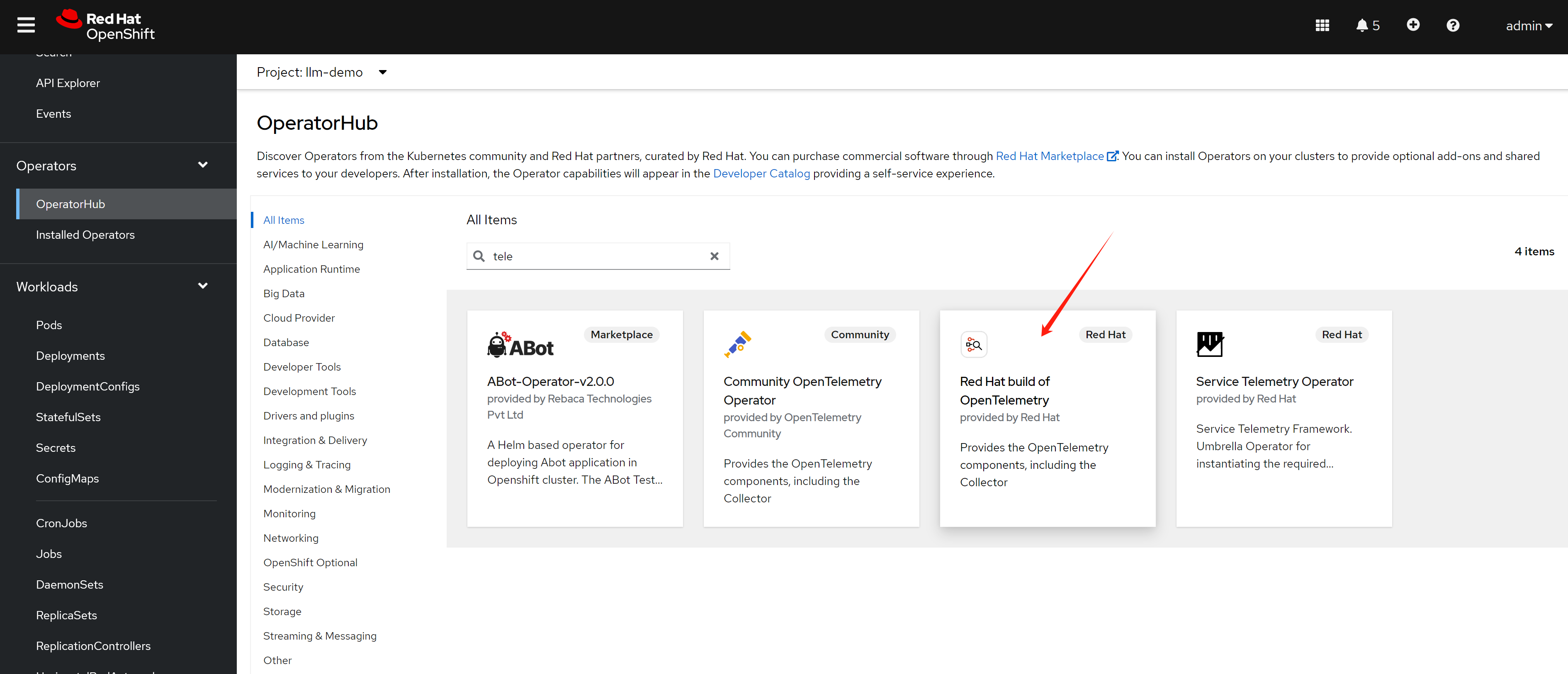
We have tempo storage in place, next, we will install the opentelementry, select from operator hub, and install with default parameter
configure a collector, with configure from offical docs
- https://docs.openshift.com/container-platform/4.14/observability/otel/otel-installing.html
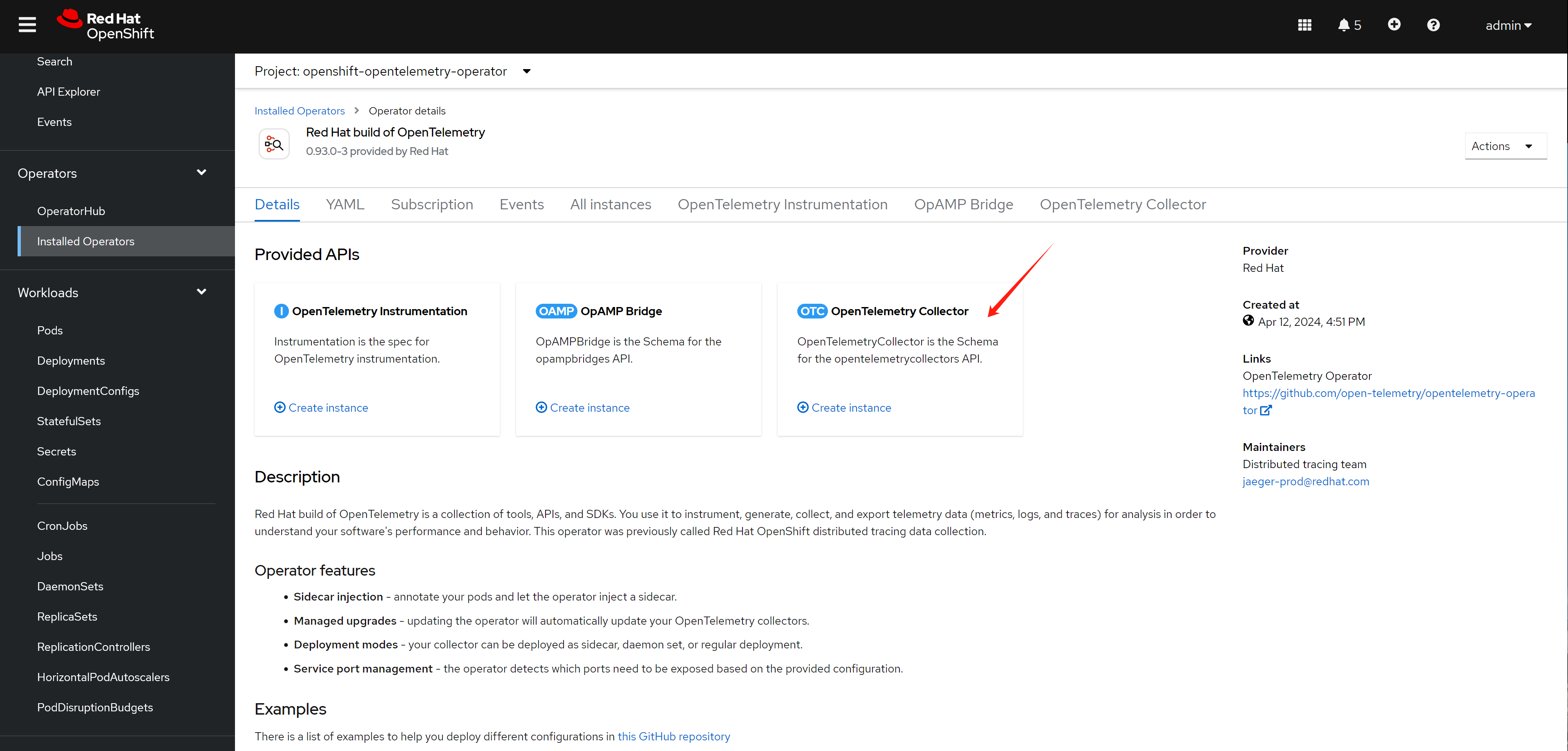
the default configue used in install doc, and with modification by author. create below in project observability
enable monitoring for user project
We need to see span metrics, this requires to enable user workload monitoring.
- https://docs.openshift.com/container-platform/4.14/observability/monitoring/enabling-monitoring-for-user-defined-projects.html
oc -n openshift-monitoring edit configmap cluster-monitoring-config


apiVersion: v1
kind: ConfigMap
metadata:
  name: cluster-monitoring-config
  namespace: openshift-monitoring
data:
  config.yaml: |
    enableUserWorkload: true
config telementry
following offical document, add telementry config.
# https://docs.openshift.com/container-platform/4.14/observability/otel/otel-forwarding.html
# add some modification

S3_NAME='observability'

cat << EOF > ${BASE_DIR}/data/install/otel-collector-codellama.yaml
---
apiVersion: v1
kind: ServiceAccount
metadata:
  name: otel-collector-deployment

---
apiVersion: rbac.authorization.k8s.io/v1
kind: ClusterRole
metadata:
  name: otel-collector
rules:
- apiGroups: ["", "config.openshift.io", "apps"]
  resources: ["pods", "namespaces", "infrastructures", "infrastructures/status", "replicasets"]
  verbs: ["get", "watch", "list"]

---
apiVersion: rbac.authorization.k8s.io/v1
kind: ClusterRoleBinding
metadata:
  name: otel-collector
subjects:
- kind: ServiceAccount
  name: otel-collector-deployment
  namespace: $S3_NAME
roleRef:
  kind: ClusterRole
  name: otel-collector
  apiGroup: rbac.authorization.k8s.io

EOF

oc create --save-config -n observability -f ${BASE_DIR}/data/install/otel-collector-codellama.yaml

# oc delete -n observability -f ${BASE_DIR}/data/install/otel-collector-codellama.yaml


cat << EOF > ${BASE_DIR}/data/install/otel-codellama.yaml
apiVersion: opentelemetry.io/v1alpha1
kind: OpenTelemetryCollector
metadata:
  name: otel
spec:
  mode: deployment
  serviceAccount: otel-collector-deployment
  observability:
    metrics:
      enableMetrics: true
  config: |
    connectors:
      spanmetrics:
        metrics_flush_interval: 15s

    receivers:
      otlp:
        protocols:
          grpc:
          http:
      jaeger:
        protocols:
          grpc:
          thrift_binary:
          thrift_compact:
          thrift_http:
      zipkin:
      opencensus:
    processors:
      batch:
      memory_limiter:
        check_interval: 1s
        limit_percentage: 50
        spike_limit_percentage: 30
      k8sattributes:
      resourcedetection:
        detectors: [openshift]
    exporters:
      prometheus:
        endpoint: 0.0.0.0:8889
        add_metric_suffixes: false
        resource_to_telemetry_conversion:
          enabled: true # by default resource attributes are dropped

      otlp:
        endpoint: "tempo-simplest-distributor.observability.svc.cluster.local:4317"
        tls:
          insecure: true

      logging:

    service:
      telemetry:
        metrics:
          address: ":8888"
      pipelines:
        traces:
          receivers: [otlp,opencensus,jaeger,zipkin]
          processors: [memory_limiter, k8sattributes, resourcedetection, batch]
          exporters: [otlp, spanmetrics,logging]
        metrics:
          receivers: [otlp,spanmetrics]
          processors: []
          exporters: [prometheus,logging]


EOF

oc create --save-config -n observability -f ${BASE_DIR}/data/install/otel-codellama.yaml

# oc delete -n observability -f ${BASE_DIR}/data/install/otel-codellama.yaml
try it out with demo app
Remember the two java app we used to test on rhel? We will use them again, to deploy them on ocp, to see how to export the trace and log to opentelementry.
manual export
We use the example above to test manual export, we set the env variable manually, and start the java app.
# go back to helper
# create a dummy pod
cat << EOF > ${BASE_DIR}/data/install/demo1.yaml
---
apiVersion: v1
kind: Service
metadata:
  name: wzh-demo-service
spec:
  ports:
    - name: service-port
      port: 80
      protocol: TCP
      targetPort: 8080
  selector:
    app: wzh-demo-pod

---
apiVersion: route.openshift.io/v1
kind: Route
metadata:
  name: wzh-demo
spec:
  to:
    kind: Service
    name: wzh-demo-service
  port:
    targetPort: service-port

---
kind: Pod
apiVersion: v1
metadata:
  name: wzh-demo-pod
  labels:
    app: wzh-demo-pod
spec:
  nodeSelector:
    kubernetes.io/hostname: 'worker-01-demo'
  restartPolicy: Always
  containers:
    - name: demo1
      image: >-
        quay.io/wangzheng422/qimgs:opentelemetry-java-examples-spring-native-2024.04.28
      env:
        - name: OTEL_SERVICE_NAME
          value: "examples-spring-native"
        - name: OTEL_EXPORTER_OTLP_ENDPOINT
          value: "http://otel-collector.observability.svc.cluster.local:4318"
        - name: OTEL_LOGS_EXPORTER
          value: "otlp"
        - name: WZH_URL
          value: "http://172.21.6.8:13000/singbox.config.json"
      # command: [ "/bin/bash", "-c", "--" ]
      # args: [ "tail -f /dev/null" ]
      # imagePullPolicy: Always

---
kind: Pod
apiVersion: v1
metadata:
  name: wzh-demo-util
spec:
  nodeSelector:
    kubernetes.io/hostname: 'worker-01-demo'
  restartPolicy: Always
  containers:
    - name: demo1
      image: >-
        quay.io/wangzheng422/qimgs:rocky9-test
      env:
        - name: key
          value: value
      command: [ "/bin/bash", "-c", "--" ]
      args: [ "tail -f /dev/null" ]
      # imagePullPolicy: Always
EOF

oc create -n llm-demo -f ${BASE_DIR}/data/install/demo1.yaml

# oc delete -n llm-demo -f ${BASE_DIR}/data/install/demo1.yaml

# while true; do
#   oc exec -it -n llm-demo wzh-demo-util -- curl http://wzh-demo-service/ping
#   sleep 1
# done

while true; do
  curl -s http://wzh-demo-llm-demo.apps.demo-gpu.wzhlab.top/ping
  sleep 1
done

# siege -q -c 1000 http://wzh-demo-llm-demo.apps.demo-gpu.wzhlab.top/ping
then, we can see the tracing result, and metric from jaeger
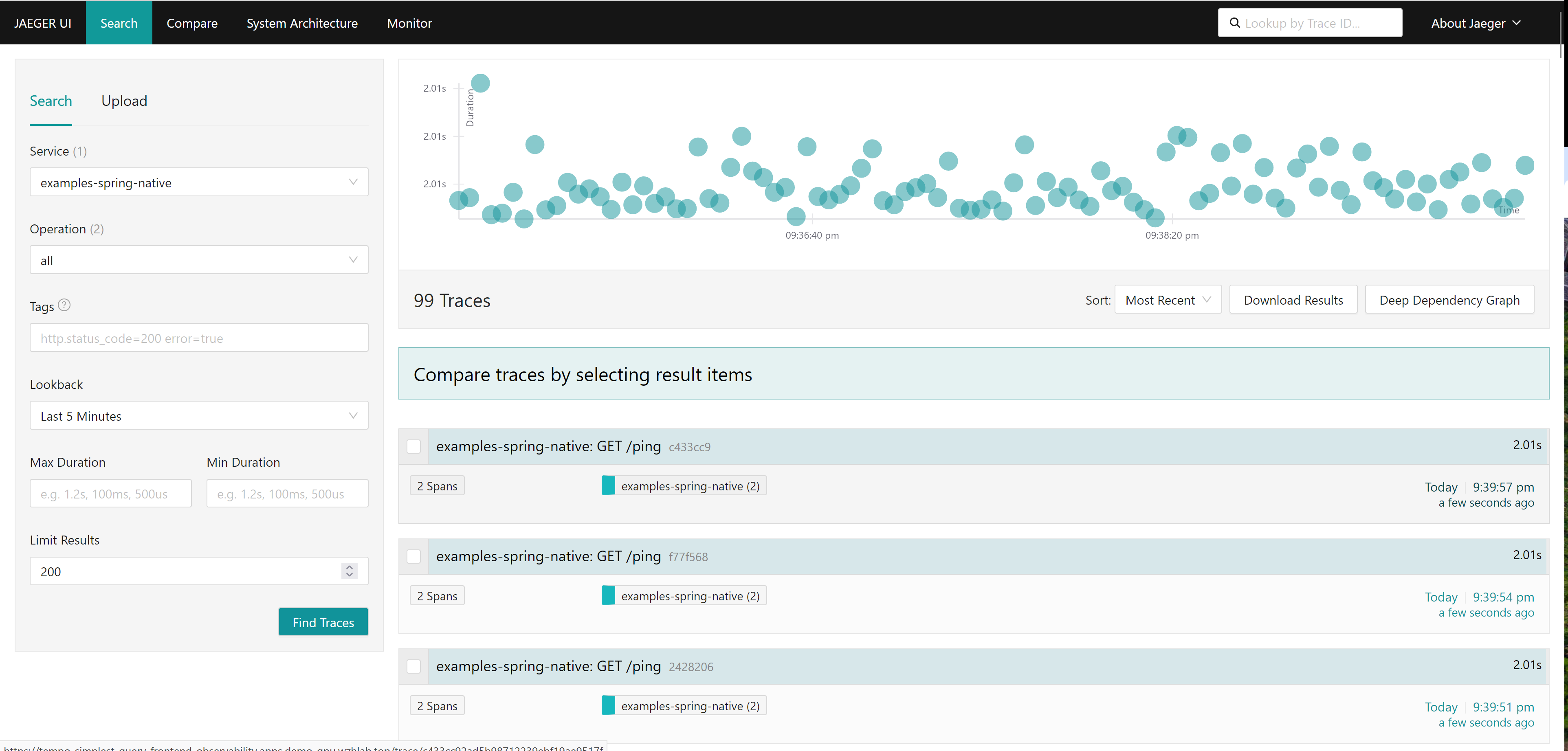
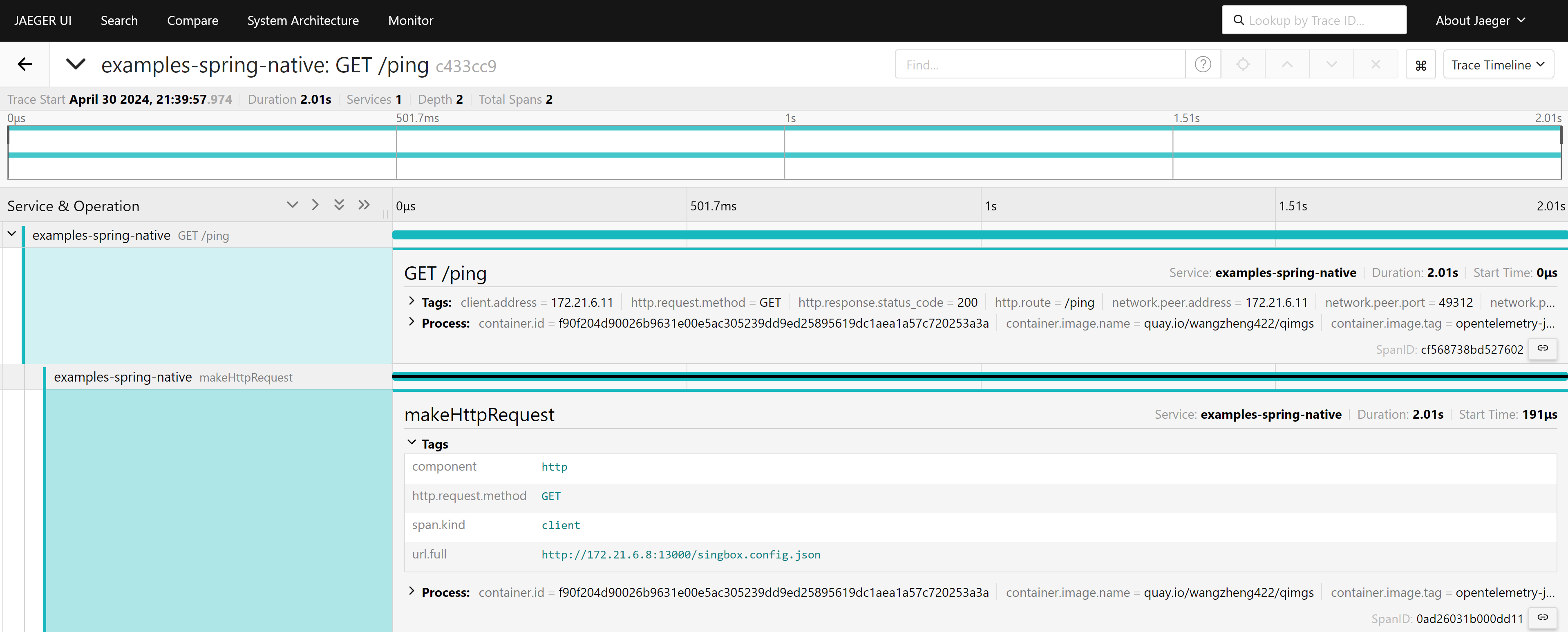
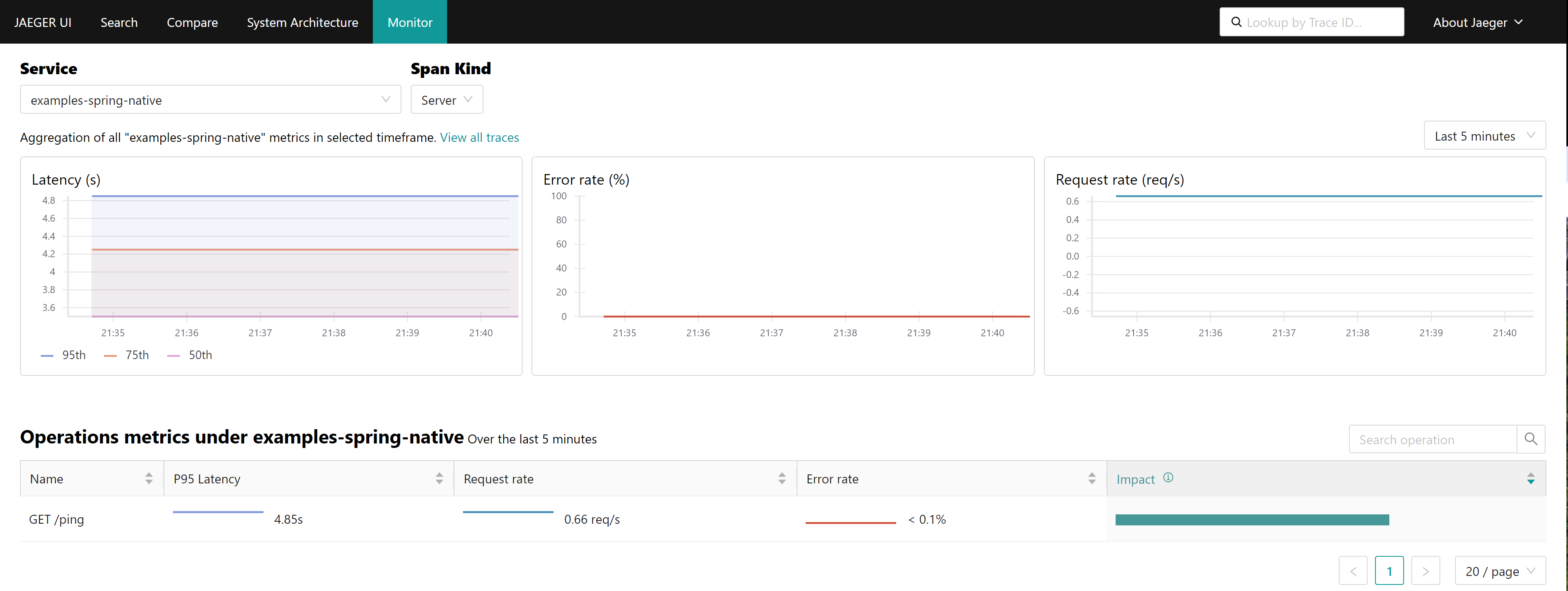
manual inject
We use the example above to test. It allow us set the export parameter manually. That means we should set the env variable by ourself, and start the java app with javaagent parameter.
# go back to helper
# create a dummy pod
cat << EOF > ${BASE_DIR}/data/install/demo1.yaml
---
apiVersion: v1
kind: Service
metadata:
  name: wzh-demo-service
spec:
  ports:
    - name: service-port
      port: 80
      protocol: TCP
      targetPort: 8080
  selector:
    app: wzh-demo-pod

---
apiVersion: route.openshift.io/v1
kind: Route
metadata:
  name: wzh-demo
spec:
  to:
    kind: Service
    name: wzh-demo-service
  port:
    targetPort: service-port

---
kind: Pod
apiVersion: v1
metadata:
  name: wzh-demo-pod
  labels:
    app: wzh-demo-pod
spec:
  nodeSelector:
    kubernetes.io/hostname: 'worker-01-demo'
  restartPolicy: Always
  containers:
    - name: demo1
      image: >-
        quay.io/wangzheng422/qimgs:javaagent-app-2024.04.28
      env:
        - name: OTEL_SERVICE_NAME
          value: "agent-example-app"
        - name: OTEL_EXPORTER_OTLP_ENDPOINT
          value: "http://otel-collector.observability.svc.cluster.local:4318"
        - name: OTEL_LOGS_EXPORTER
          value: "otlp"
        - name: WZH_URL
          value: "http://172.21.6.8:13000/singbox.config.json"
      # command: [ "/bin/bash", "-c", "--" ]
      # args: [ "tail -f /dev/null" ]
      # imagePullPolicy: Always

---
kind: Pod
apiVersion: v1
metadata:
  name: wzh-demo-util
spec:
  nodeSelector:
    kubernetes.io/hostname: 'worker-01-demo'
  restartPolicy: Always
  containers:
    - name: demo1
      image: >-
        quay.io/wangzheng422/qimgs:rocky9-test
      env:
        - name: key
          value: value
      command: [ "/bin/bash", "-c", "--" ]
      args: [ "tail -f /dev/null" ]
      # imagePullPolicy: Always
EOF

oc create -n llm-demo -f ${BASE_DIR}/data/install/demo1.yaml

# oc delete -n llm-demo -f ${BASE_DIR}/data/install/demo1.yaml

# while true; do
#   oc exec -it -n llm-demo wzh-demo-util -- curl http://wzh-demo-service/ping
#   sleep 1
# done

while true; do
  curl -s http://wzh-demo-llm-demo.apps.demo-gpu.wzhlab.top/ping
  sleep 1
done
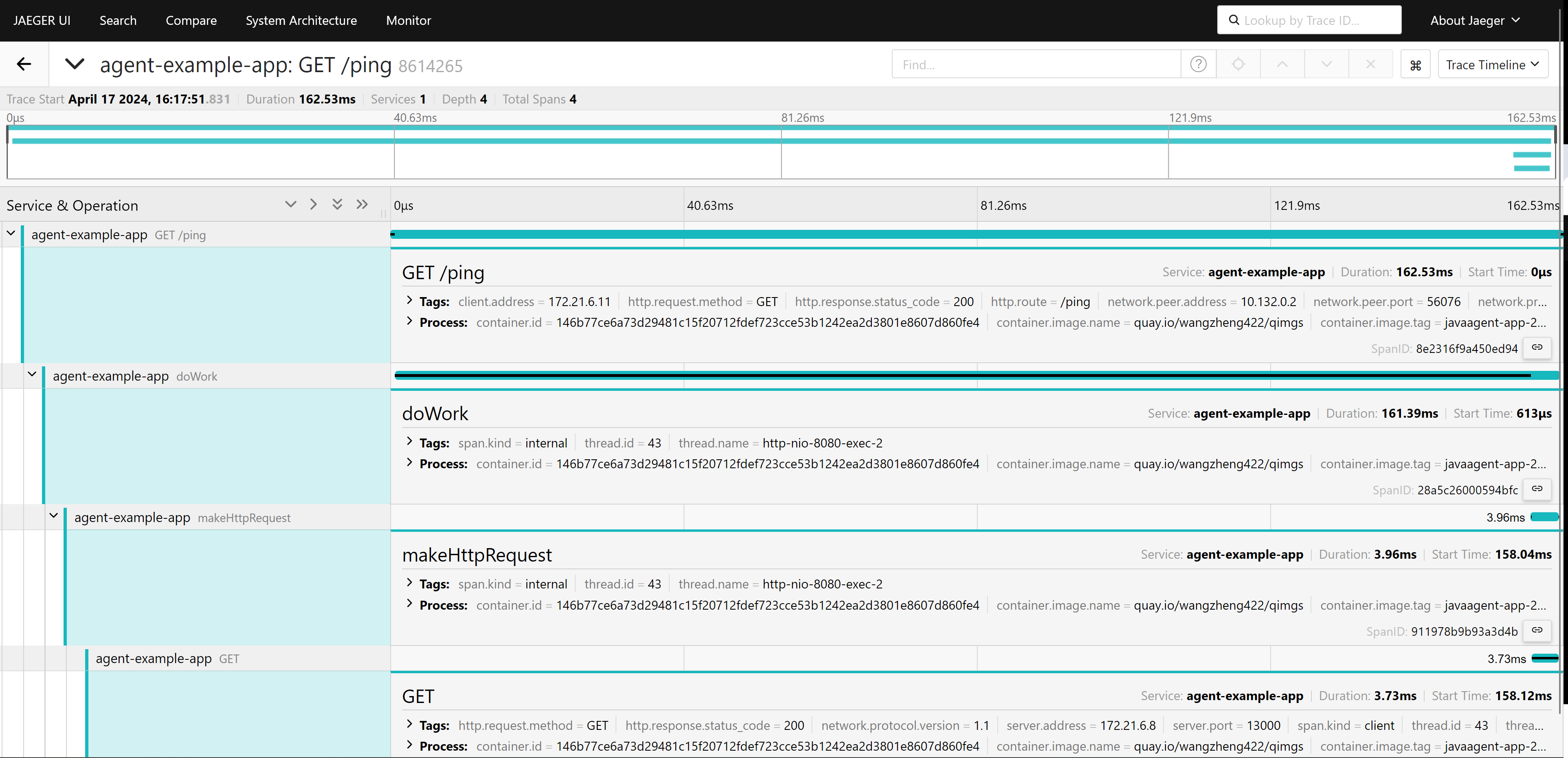
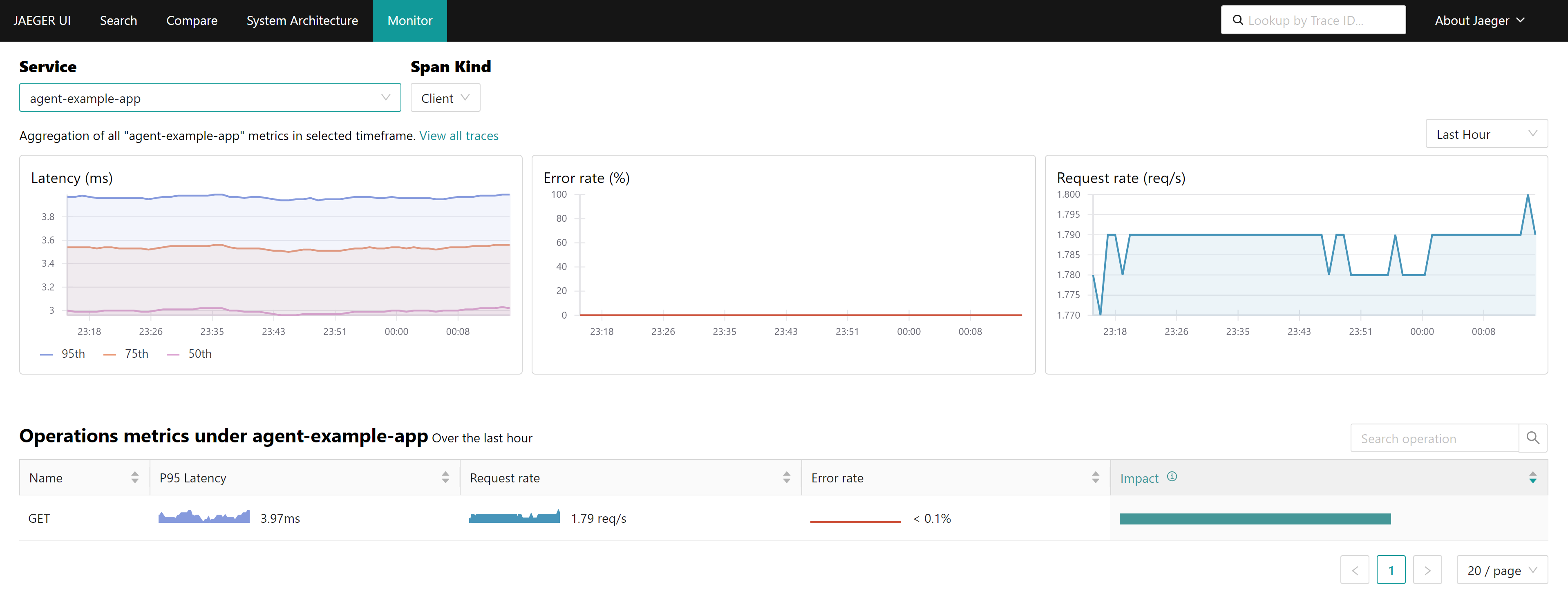
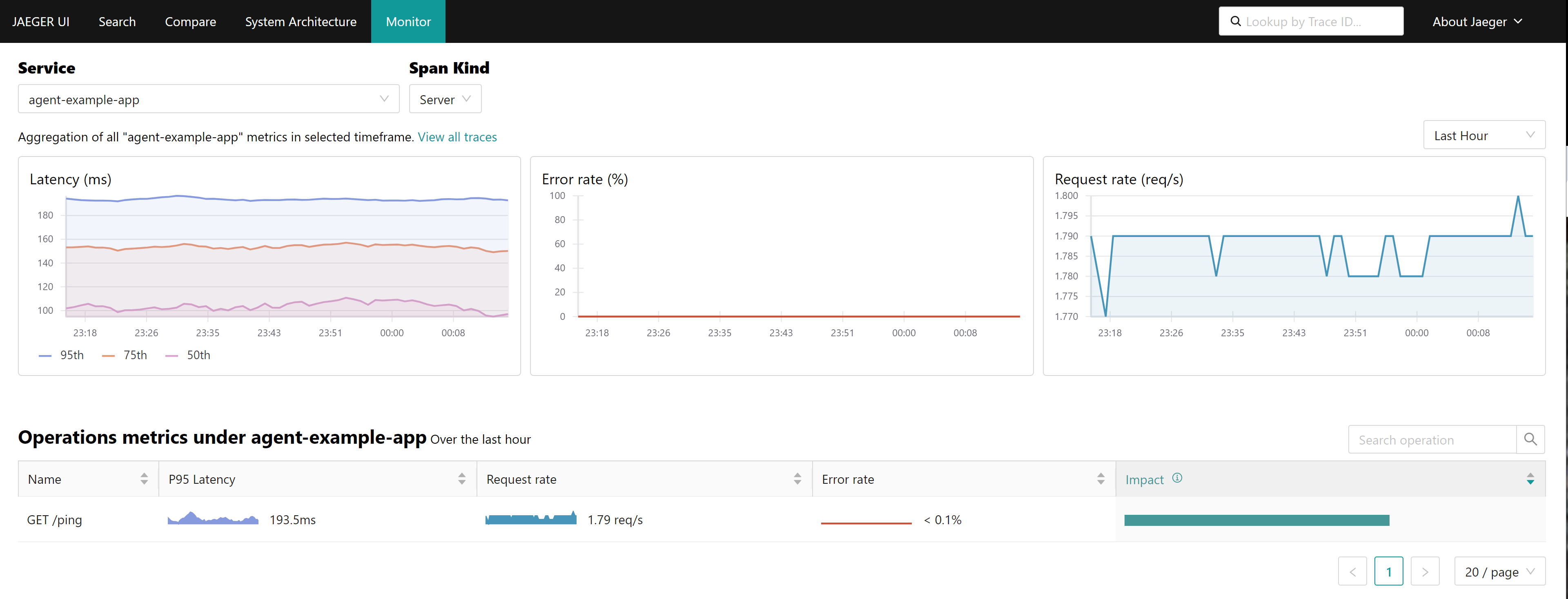
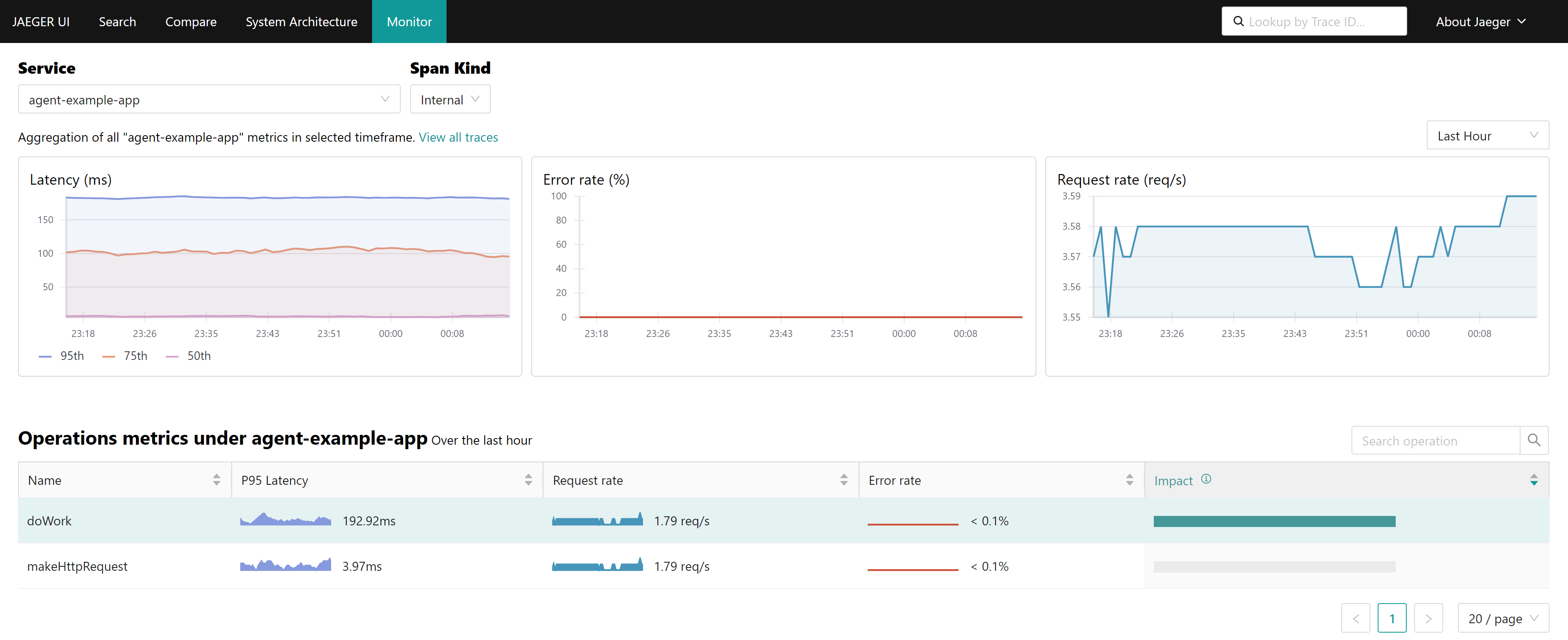
From the UI, you can see the RTT to the backend.
- https://tempo-simplest-query-frontend-observability.apps.demo-gpu.wzhlab.top/search
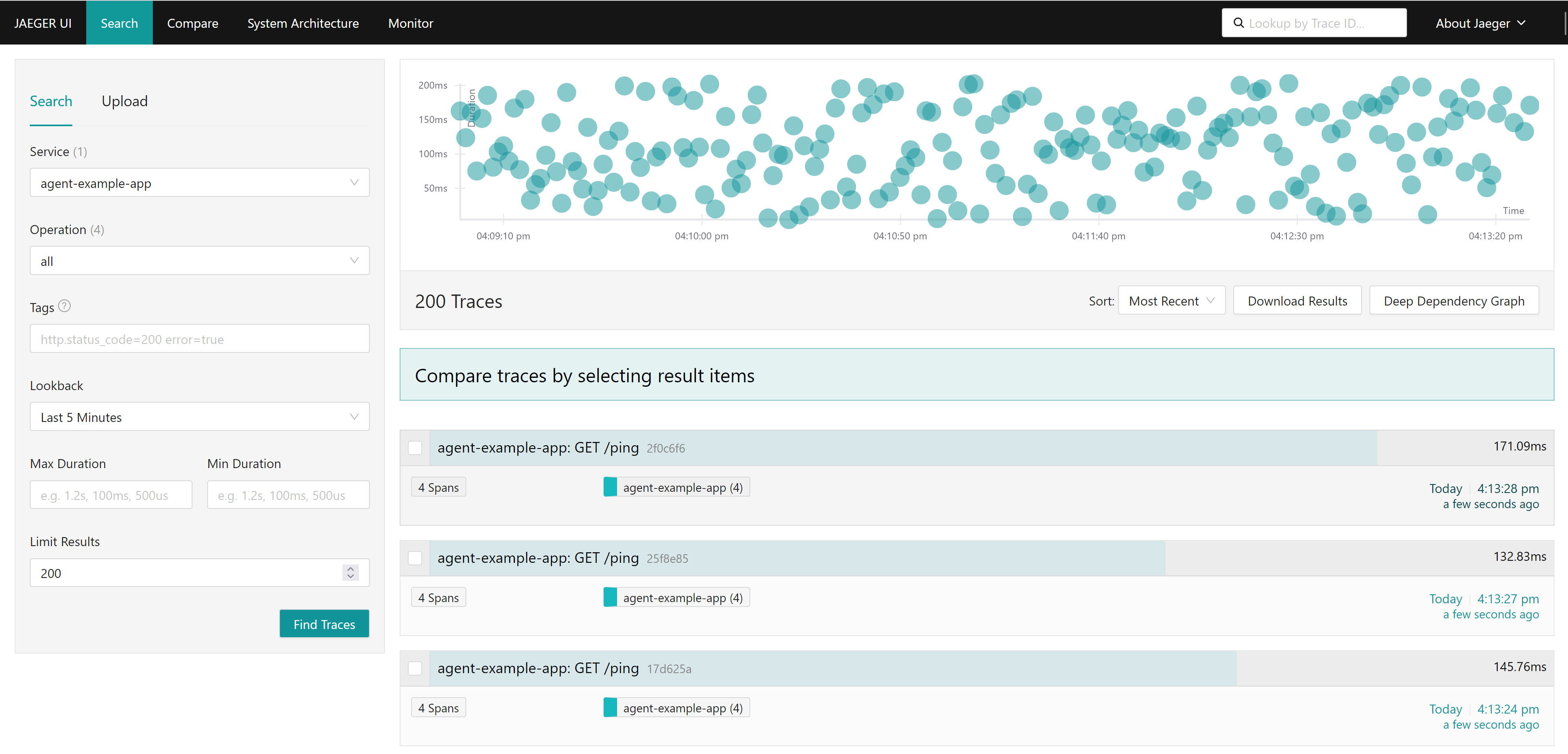
auto inject
In above example, the env variable is set manually, in next example, we will set the env variable automatically, by using the auto-inject feature from opentelementry.
cat << EOF > ${BASE_DIR}/data/install/java-instrumentation-codellama.yaml
apiVersion: opentelemetry.io/v1alpha1
kind: Instrumentation
metadata:
  name: java-instrumentation
spec:
  env:
    - name: OTEL_EXPORTER_OTLP_TIMEOUT
      value: "20"
  exporter:
    endpoint: http://otel-collector.observability.svc.cluster.local:4317
  propagators:
    - tracecontext
    - baggage
  sampler:
    type: parentbased_traceidratio
    argument: "0.25"
  java:
    env:
    - name: OTEL_JAVAAGENT_DEBUG
      value: "true"

EOF

oc create --save-config -n llm-demo -f ${BASE_DIR}/data/install/java-instrumentation-codellama.yaml

# oc delete -n llm-demo -f ${BASE_DIR}/data/install/java-instrumentation-codellama.yaml
create app pods, add an annotation to enable auto-inject.
# go back to helper
# create a dummy pod
cat << EOF > ${BASE_DIR}/data/install/demo1.yaml
---
apiVersion: v1
kind: Service
metadata:
  name: wzh-demo-service
spec:
  ports:
    - name: service-port
      port: 80
      protocol: TCP
      targetPort: 8080
  selector:
    app: wzh-demo-pod

---
apiVersion: route.openshift.io/v1
kind: Route
metadata:
  name: wzh-demo
spec:
  to:
    kind: Service
    name: wzh-demo-service
  port:
    targetPort: service-port

---
kind: Pod
apiVersion: v1
metadata:
  name: wzh-demo-pod
  labels:
    app: wzh-demo-pod
  annotations:
    instrumentation.opentelemetry.io/inject-java: "true"
spec:
  nodeSelector:
    kubernetes.io/hostname: 'worker-01-demo'
  restartPolicy: Always
  containers:
    - name: demo1
      image: >-
        quay.io/wangzheng422/qimgs:simple-java-http-server-2024.04.24
      env:
        - name: WZH_URL
          value: "http://172.21.6.8:13000/singbox.config.json"
      # command: [ "/bin/bash", "-c", "--" ]
      # args: [ "tail -f /dev/null" ]
      # imagePullPolicy: Always

# ---
# kind: Pod
# apiVersion: v1
# metadata:
#   name: wzh-demo-util
# spec:
#   nodeSelector:
#     kubernetes.io/hostname: 'worker-01-demo'
#   restartPolicy: Always
#   containers:
#     - name: demo1
#       image: >-
#         quay.io/wangzheng422/qimgs:rocky9-test
#       env:
#         - name: key
#           value: value
#       command: [ "/bin/bash", "-c", "--" ]
#       args: [ "tail -f /dev/null" ]
#       # imagePullPolicy: Always
EOF

oc apply -n llm-demo -f ${BASE_DIR}/data/install/demo1.yaml

# oc delete -n llm-demo -f ${BASE_DIR}/data/install/demo1.yaml

# while true; do
#   oc exec -it -n llm-demo wzh-demo-util -- curl http://wzh-demo-service/sendRequest
#   sleep 1
# done

while true; do
  curl -s http://wzh-demo-llm-demo.apps.demo-gpu.wzhlab.top/sendRequest
  sleep 1
done
check what opentelemtry add to pod, we can see, first, it adds an init container, to copy the javaagent.jar to the container, and then set the env variable for the container.
oc get pod wzh-demo-pod -n llm-demo -o yaml | yq .spec.initContainers
# - command:
#     - cp
#     - /javaagent.jar
#     - /otel-auto-instrumentation-java/javaagent.jar
#   image: ghcr.io/open-telemetry/opentelemetry-operator/autoinstrumentation-java:1.32.0
#   imagePullPolicy: IfNotPresent
#   name: opentelemetry-auto-instrumentation-java
#   resources:
#     limits:
#       cpu: 500m
#       memory: 64Mi
#     requests:
#       cpu: 50m
#       memory: 64Mi
#   securityContext:
#     capabilities:
#       drop:
#         - MKNOD
#   terminationMessagePath: /dev/termination-log
#   terminationMessagePolicy: File
#   volumeMounts:
#     - mountPath: /otel-auto-instrumentation-java
#       name: opentelemetry-auto-instrumentation-java
#     - mountPath: /var/run/secrets/kubernetes.io/serviceaccount
#       name: kube-api-access-2spqc
#       readOnly: true


oc get pod wzh-demo-pod -n llm-demo -o yaml | yq .spec.containers[0].env
# - name: WZH_URL
#   value: http://172.21.6.8:13000
# - name: OTEL_JAVAAGENT_DEBUG
#   value: "true"
# - name: JAVA_TOOL_OPTIONS
#   value: ' -javaagent:/otel-auto-instrumentation-java/javaagent.jar'
# - name: OTEL_EXPORTER_OTLP_TIMEOUT
#   value: "20"
# - name: OTEL_SERVICE_NAME
#   value: wzh-demo-pod
# - name: OTEL_EXPORTER_OTLP_ENDPOINT
#   value: http://otel-collector.observability.svc.cluster.local:4317
# - name: OTEL_RESOURCE_ATTRIBUTES_NODE_NAME
#   valueFrom:
#     fieldRef:
#       apiVersion: v1
#       fieldPath: spec.nodeName
# - name: OTEL_PROPAGATORS
#   value: tracecontext,baggage
# - name: OTEL_TRACES_SAMPLER
#   value: parentbased_traceidratio
# - name: OTEL_TRACES_SAMPLER_ARG
#   value: "0.25"
# - name: OTEL_RESOURCE_ATTRIBUTES
#   value: k8s.container.name=demo1,k8s.namespace.name=llm-demo,k8s.nod
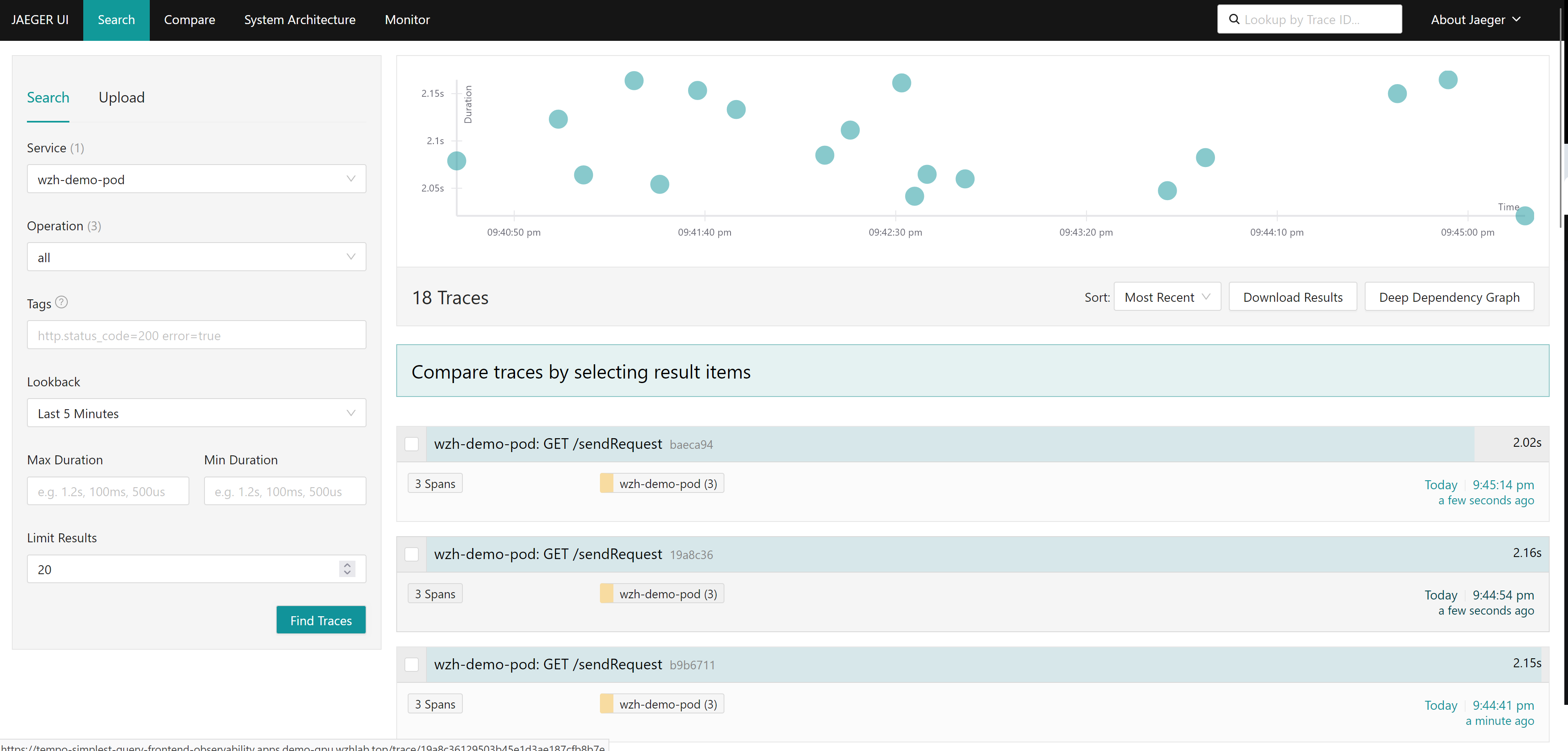
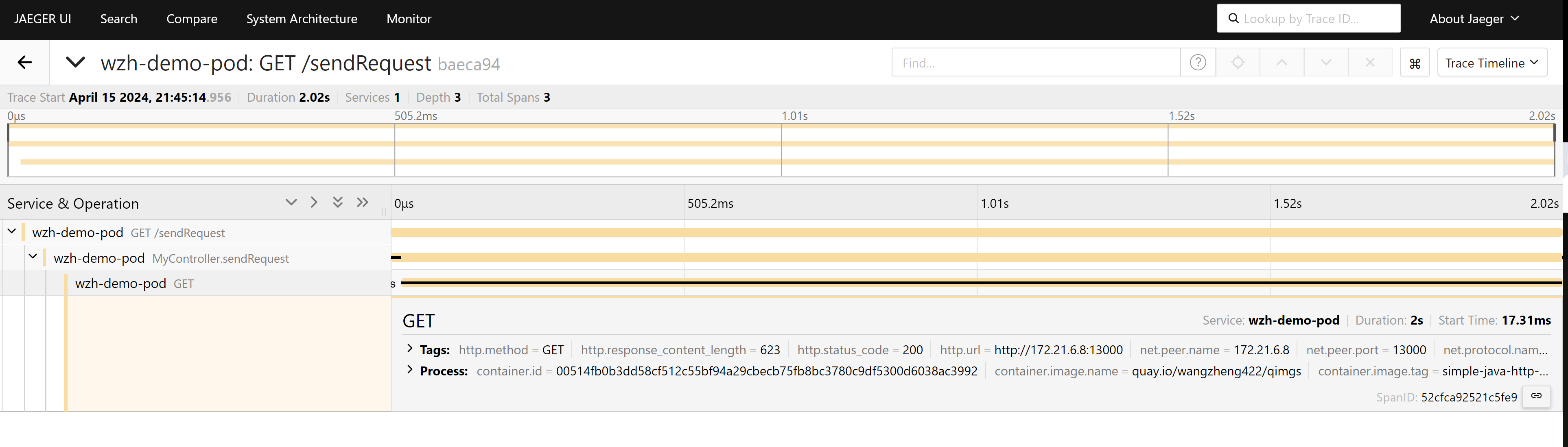
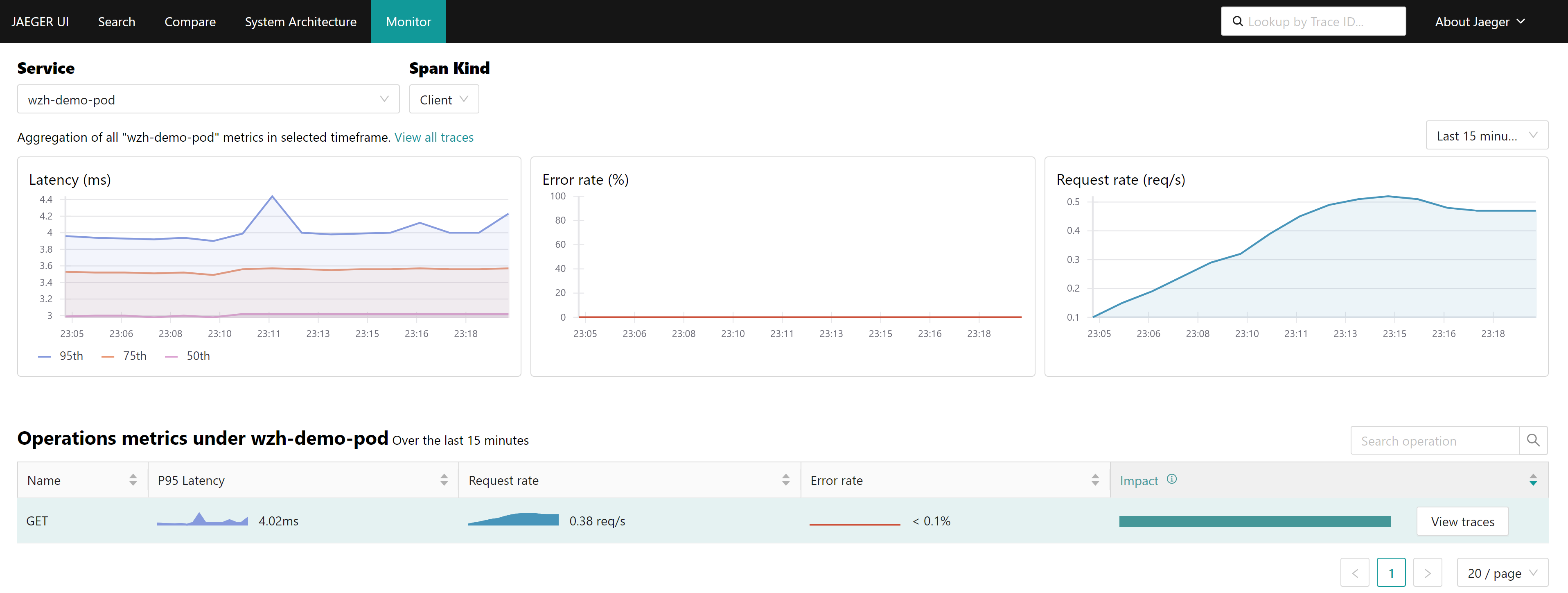
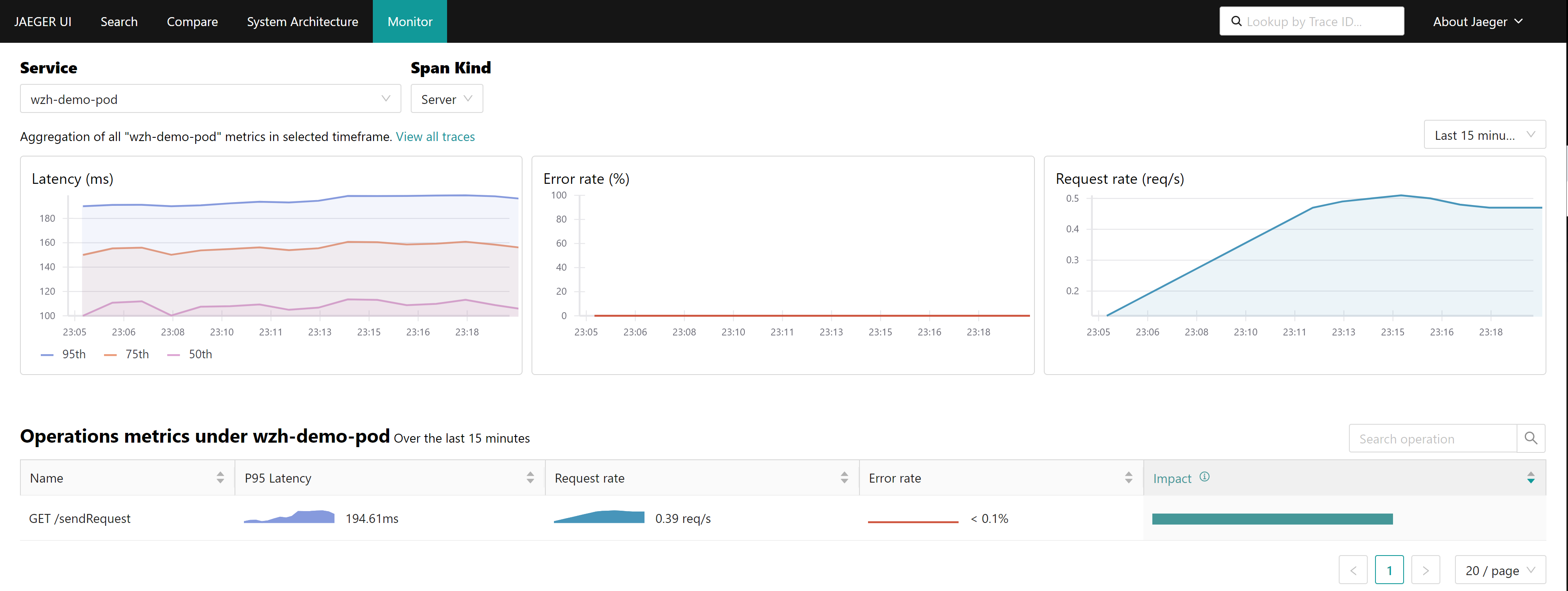
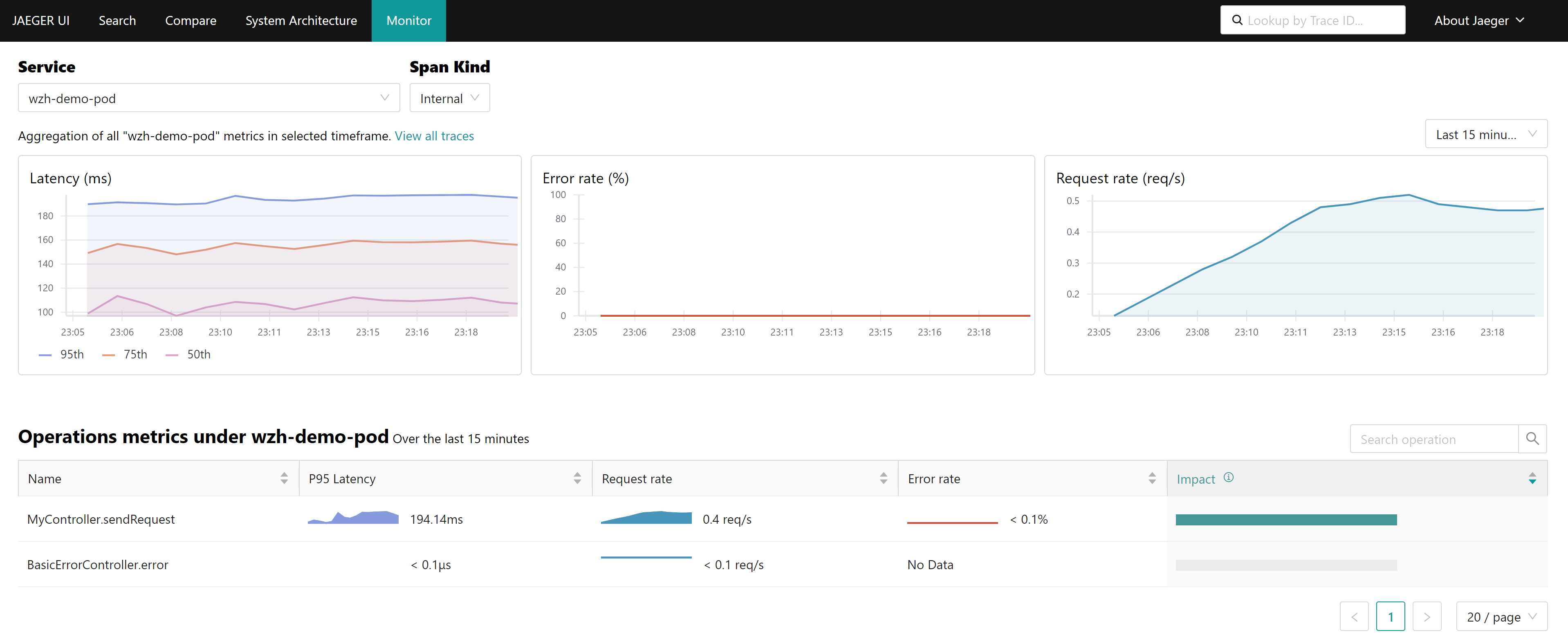
you can see the result from tempo frontend:
benchmark testing
we want to check how the opentelementry affect the performance, we will use siege to test the performance.
# on the backend server
# create a python server with concurrent serving capabilities
cd /data/py.test
cat << EOF > httpdemo.py
from http.server import ThreadingHTTPServer, SimpleHTTPRequestHandler

def run(server_class=ThreadingHTTPServer, handler_class=SimpleHTTPRequestHandler):
    server_address = ('', 13000)
    httpd = server_class(server_address, handler_class)
    httpd.serve_forever()

if __name__ == '__main__':
    run()
EOF

python3 httpdemo.py


# on the helper, client side, using ab tools to make the call
dnf install httpd-tools -y

while true; do
  ab -t $((5*60)) -c 1000 http://wzh-demo-llm-demo.apps.demo-gpu.wzhlab.top/sendRequest
done

dnf install siege -y

# below will generate 90Mbps traffic load, because the app will sleep random ms
siege -q -c 1000 http://wzh-demo-llm-demo.apps.demo-gpu.wzhlab.top/sendRequest
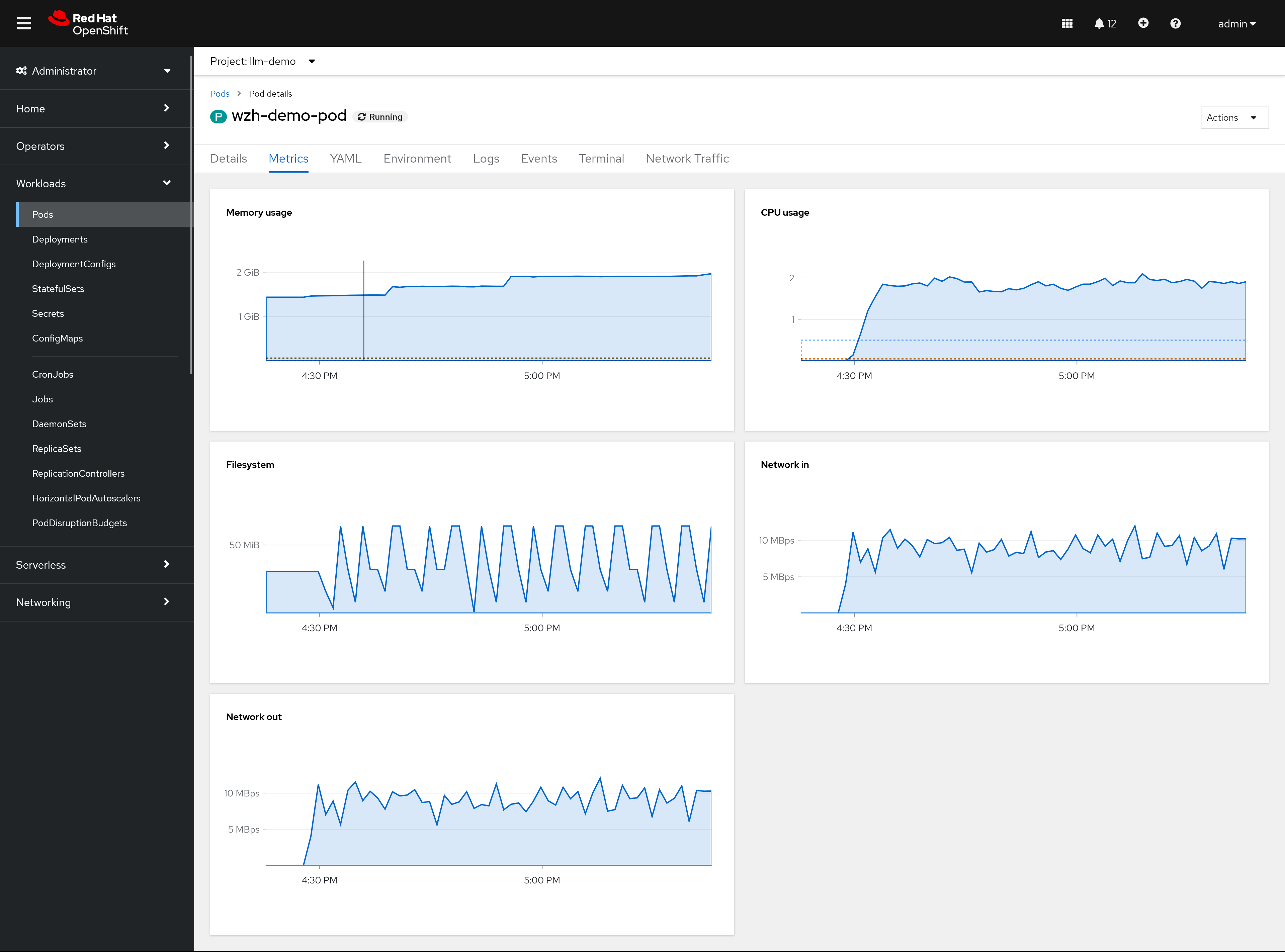
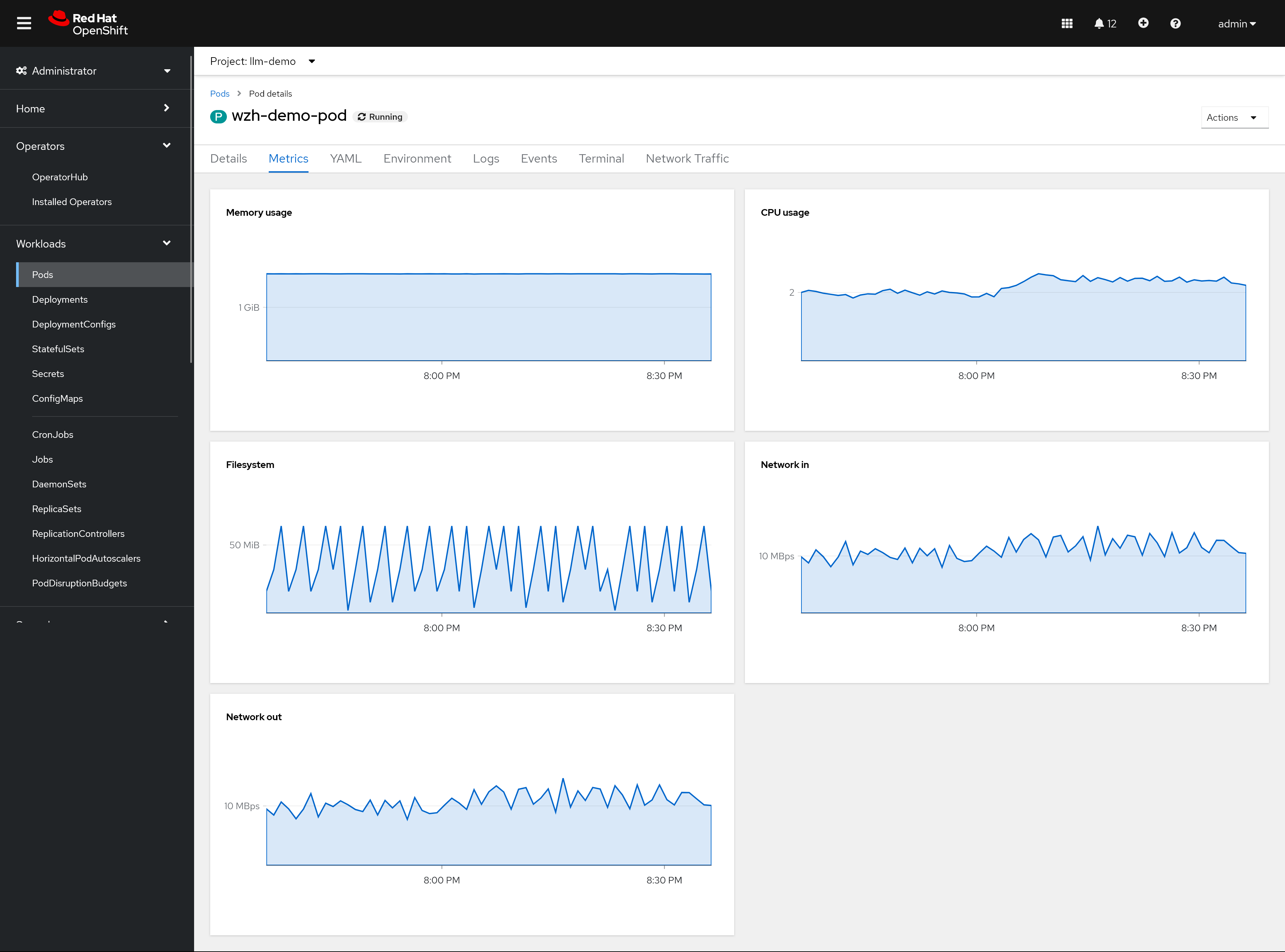
This is the overall metrics of the pod, our load is not such high, so comparing to the normal run (without bytecode-injection), the performance is almost the same, and with bytecode-injection, the performance is slightly lower.
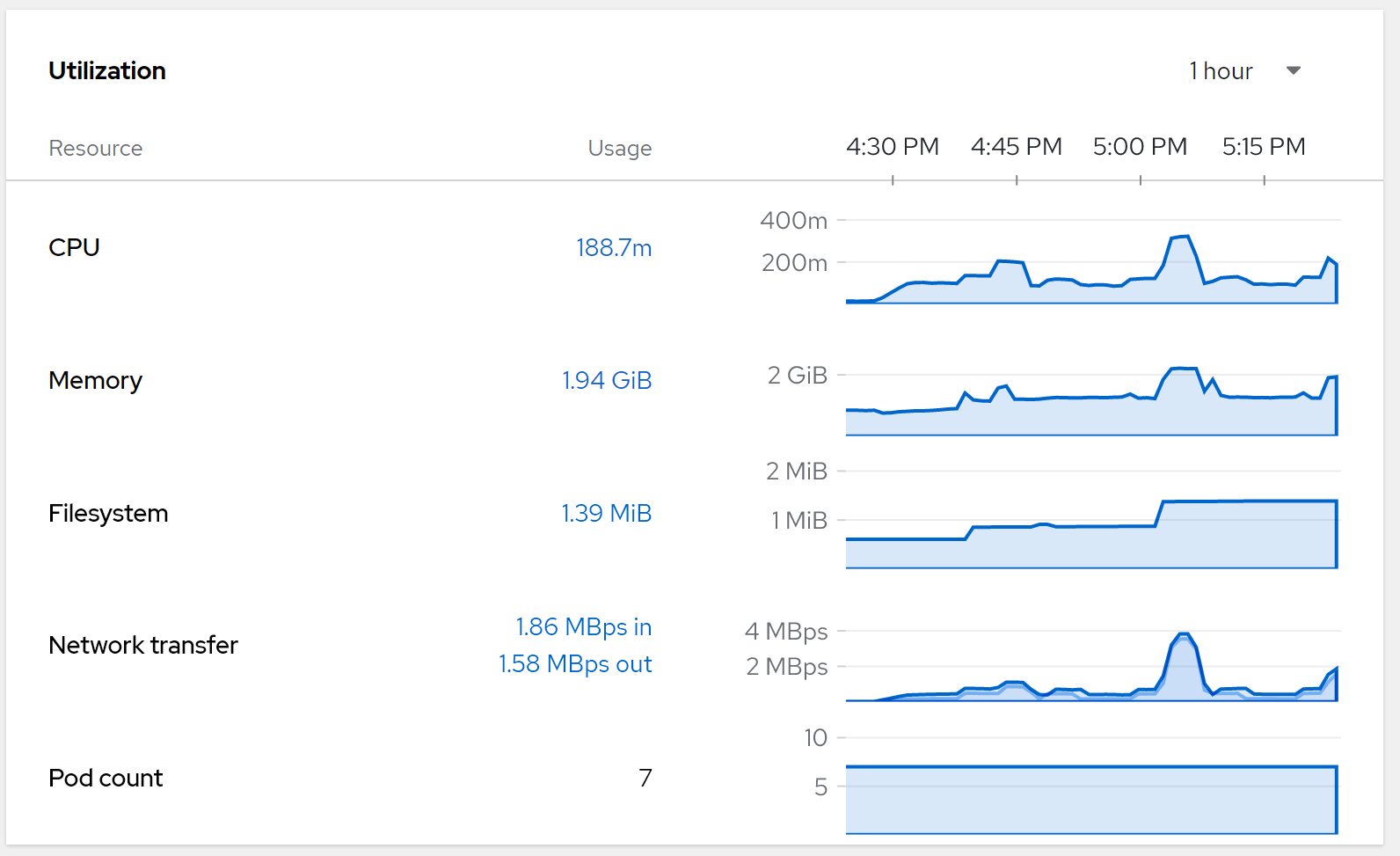
This is the performance overview of the observability project/namespace.
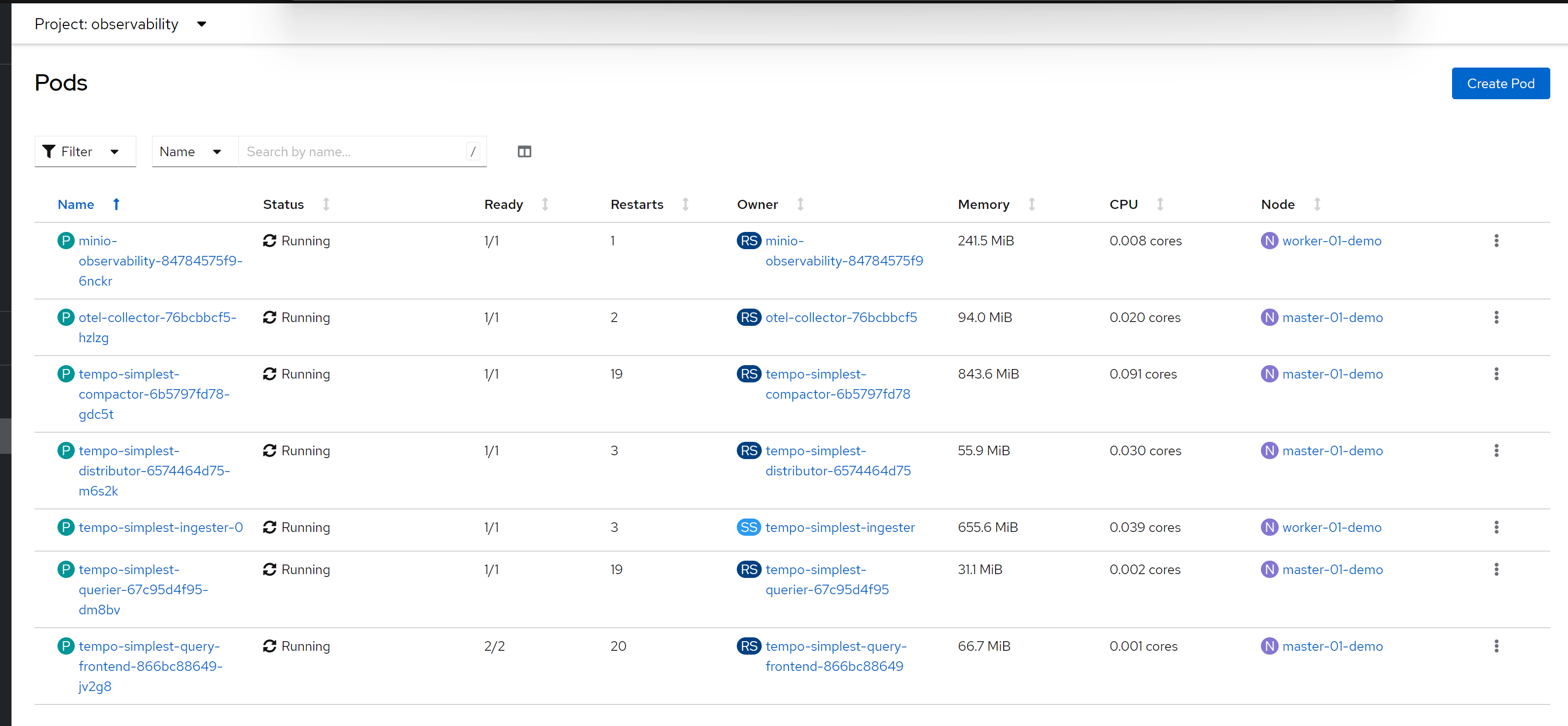
This is pod overview of the observabiltiy project/namespace
check the pvc usage, by checking the storage usage
# on helper node, get the pv name
oc get pvc -n observability
# NAME                             STATUS   VOLUME                                     CAPACITY   ACCESS MODES   STORAGECLASS   AGE
# data-tempo-simplest-ingester-0   Bound    pvc-51fe5076-b579-4d09-88d1-2b94e836cf26   7151Gi     RWO            hostpath-csi   18d
# minio-observability-pvc          Bound    pvc-6c4ba968-d69e-4c44-abef-ad3dfb9d45db   7151Gi     RWO            hostpath-csi   18d

# on worker-01, get the dir size
du -hs {pvc-51fe5076-b579-4d09-88d1-2b94e836cf26,pvc-6c4ba968-d69e-4c44-abef-ad3dfb9d45db}
# 62M     pvc-51fe5076-b579-4d09-88d1-2b94e836cf26
# 6.6M    pvc-6c4ba968-d69e-4c44-abef-ad3dfb9d45db
So, in our test case, the storage usage is around 100MB/5mins
normal run
to compare, just run normal without bytecode-injection
# go back to helper
# create a dummy pod
cat << EOF > ${BASE_DIR}/data/install/demo1.yaml
---
apiVersion: v1
kind: Service
metadata:
  name: wzh-demo-service
spec:
  ports:
    - name: service-port
      port: 80
      protocol: TCP
      targetPort: 8080
  selector:
    app: wzh-demo-pod

---
apiVersion: route.openshift.io/v1
kind: Route
metadata:
  name: wzh-demo
spec:
  to:
    kind: Service
    name: wzh-demo-service
  port:
    targetPort: service-port

---
kind: Pod
apiVersion: v1
metadata:
  name: wzh-demo-pod
  labels:
    app: wzh-demo-pod
  # annotations:
  #   instrumentation.opentelemetry.io/inject-java: "true"
spec:
  nodeSelector:
    kubernetes.io/hostname: 'worker-01-demo'
  restartPolicy: Always
  containers:
    - name: demo1
      image: >-
        quay.io/wangzheng422/qimgs:simple-java-http-server-2024.04.24
      env:
        - name: WZH_URL
          value: "http://172.21.6.8:13000/singbox.config.json"
      # command: [ "/bin/bash", "-c", "--" ]
      # args: [ "tail -f /dev/null" ]
      # imagePullPolicy: Always

EOF

oc apply -n llm-demo -f ${BASE_DIR}/data/install/demo1.yaml

# oc delete -n llm-demo -f ${BASE_DIR}/data/install/demo1.yaml


# on the helper, client side, using ab tools to make the call
dnf install httpd-tools -y

while true; do
  ab -t $((5*60)) -c 1000 http://wzh-demo-llm-demo.apps.demo-gpu.wzhlab.top/sendRequest
done


dnf install siege -y

siege -q -c 1000 http://wzh-demo-llm-demo.apps.demo-gpu.wzhlab.top/sendRequest
The result is almost the same, so we can see the performance is not significantly affected by the opentelementry.
limitation
- It is TP right now, but can move to GA based on customer requirement.
- It costs more resource, because it need to inject the bytecode to the java app, and collect the log and trace, especially for heavy load apps.